
Entering Nigeria from Japan: what to check before you commit
Interest from Japanese companies is real, and so are the risks. Here is what to check, in what order, before you put money into the Nigerian market.
By Joseph Emmanuel, Founder, Jemirae6 min read
Nigeria keeps coming up in board meetings in Tokyo and Osaka. It's the most populous country in Africa, its economy was rebased to a much larger size in 2025, and Japan's trade agency has spent a decade building a presence at the Lagos International Trade Fair. Yet the Japanese companies already operating there are honest about it: the market is large, and it's hard.
This guide is for decision makers who want a clear view before they commit budget. It isn't legal or tax advice. It's the order of questions we'd work through with any company looking at Nigeria, with the evidence we'd want on the table.
The short version
Nigeria rewards companies that enter in stages, price for currency risk from day one, and work through strong local partners. It punishes companies that treat it like a single, easy market to plug into from abroad.
If you only take one thing from this article: test demand and your partner model before you set up a full company.
Why Japanese companies are looking at Nigeria now
A few things have changed the conversation in the last two years.
- Scale. JETRO describes Nigeria as having a population of about 240 million, the largest in Africa (JETRO, October 2025).
- A bigger measured economy. In July 2025 Nigeria's statistics bureau rebased GDP to a 2019 base year. Nominal GDP for 2024 rose to about ₦372.8 trillion, roughly US$243 billion, a 34% upward revision (Daily Trust, Channels TV). Analysts are quick to point out that rebasing changes the measurement, not people's incomes (Agusto & Co.).
- Policy attention from Japan. At TICAD 9 in Yokohama in August 2025, Nigerian reporting highlighted a JICA-supported US$190 million facility for distributed renewable energy, and talks with Japanese power and mining players (Guardian Nigeria, TheCable).
- A steady trade presence. The 2025 Lagos fair was JETRO's tenth year there, with 39 exhibitors in the Japan Pavilion and a first pop culture event, "Super Japan in Lagos" (JETRO).
What the companies already there are saying
At the 2025 fair, Japan's ambassador to Nigeria, Suzuki Hideo, said there were about 52 Japanese companies operating in the country, and that many of them weren't yet making a profit. He added that they "have to think for the longer term" (ThisDay).
JETRO's managing director in Nigeria, Takashi Oku, made a related point in the same report: partnerships with Nigerian companies had worked well for the Japanese firms that use them.
That's the pattern we see too. The companies that do well treat Nigeria as a long build, not a quick sales channel, and they let local partners carry the parts of the business that depend on local knowledge.
Five things to check before you commit
1. Currency: price it in from the start
The naira has been through major reform. In June 2023 the Central Bank of Nigeria let the exchange rate be set much more by the market, which led to a steep fall in the naira's value. In December 2024 it launched an electronic foreign exchange matching system, and in January 2025 it said it had cleared a backlog of about US$7 billion in delayed foreign exchange payments to companies (BusinessDay, Investorsking).
For you, that means:
- Build your business case in naira first, then stress test it at weaker exchange rates.
- Plan how and when you'll move money out, and how long that can take.
- Decide early which costs you'll carry in dollars or yen and which in naira.
2. Company setup: know the steps, then confirm the details
Companies are registered with the Corporate Affairs Commission under the Companies and Allied Matters Act 2020. A company with foreign shareholders will usually also deal with the Nigerian Investment Promotion Commission, and with the Ministry of Interior for a business permit and an expatriate quota if you plan to bring in staff from abroad.
The details, especially minimum share capital for companies with foreign participation, have changed in recent years, and secondary sources don't agree on the current figures. Confirm them with the Corporate Affairs Commission, the Nigerian Investment Promotion Commission or a Nigerian law firm before you plan around a number.
3. Partners: decide what you'll own and what a partner will run
Most of the risk in Nigeria sits in distribution, collections, hiring and dealing with agencies. These are exactly the areas where a capable local partner earns their share. Before you sign anything:
- Check the partner's track record with other foreign companies, not just their network.
- Agree who owns the customer relationship and the data.
- Write down what happens if volumes fall short in year one.
4. Customers: test demand in one city, with one offer
Nigeria is several very different markets. Lagos, Abuja and Port Harcourt behave differently, and so do consumers and large companies. Pick one city and one offer, and get real buyers to commit, even in a small way, before you scale.
Digital channels help here. Many Nigerian buyers research and pay on their phones, so a clear website, simple local payment options and fast replies on the channels people already use can tell you a lot about demand before you open an office.
5. Operations: plan for power, logistics and people
Reliable electricity is still a cost line, not a given, which is one reason power featured so heavily at TICAD 9. Budget for backup power, realistic delivery times and the time it takes to hire and train a strong local team. Our own view, from working across Nigeria: good people are there, and they move fast when the systems around them are clear.
A sensible order of work
- Desk research. Size the opportunity for your product, map competitors and read the current rules.
- Talk to buyers and partners. A short trip, or remote interviews, with ten to twenty potential customers and three to five possible partners.
- Run a pilot. Sell through a partner or a small local setup for three to six months, and measure demand, margins and how long cash takes to come back.
- Then set up properly. Register, hire and invest once the pilot shows the model works.
This order costs less, and it gives your board real numbers instead of a forecast.
Where Jemirae fits
We help companies, especially from Japan, decide whether Nigeria is right for them, find vetted local partners and build the digital side of their entry, from the website to the systems that run the business. Our strategy team is in Tokyo and our design and engineering team works across Nigeria, so both sides of the conversation are covered.
If you're weighing Nigeria, our Market Access page explains how we work, or you can book a call and tell us where you are.
Sources
- JETRO, "JETRO to Host Super Japan in Lagos for the First Time", 23 October 2025.
- ThisDay, "JETRO Boss: How Japanese Businesses are Coping in Nigeria", 10 November 2025.
- Daily Trust and Channels Television, reporting on Nigeria's GDP rebasing, July 2025.
- Agusto & Co., "Nigeria's Rebased GDP: New Numbers, Old Problems", 2025.
- Guardian Nigeria and TheCable, "Nigeria at TICAD 9", August 2025.
- BusinessDay and Investorsking, reporting on Central Bank of Nigeria foreign exchange reforms, 2025.
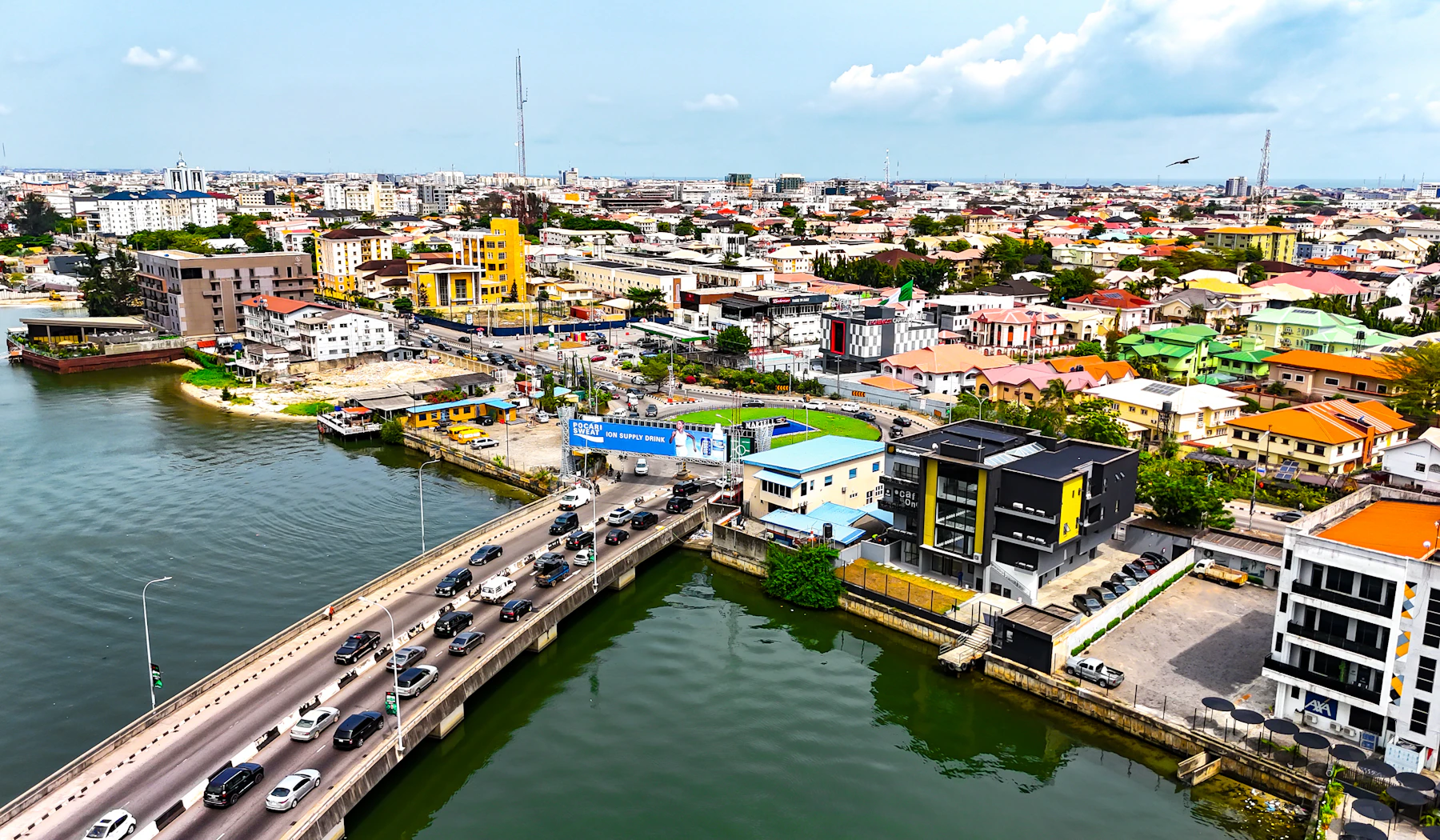
- Cover photo: Tunde Buremo, aerial view of the Lekki-Ikoyi Link Bridge, Lagos, Unsplash, free to use under the Unsplash License. unsplash.com/photos/n8DxalbQBic
Tell us what you're working on. We'll tell you honestly whether we can help, and what we'd do first.