
Jemirae concept study
KIMERU: steel decision and release control
Concept Study 002. Decide before the factory waits.
- Concept study
- Japan
- Steel construction
- Industrial software
- Product design
- Engineering
- 3D
- English and Japanese
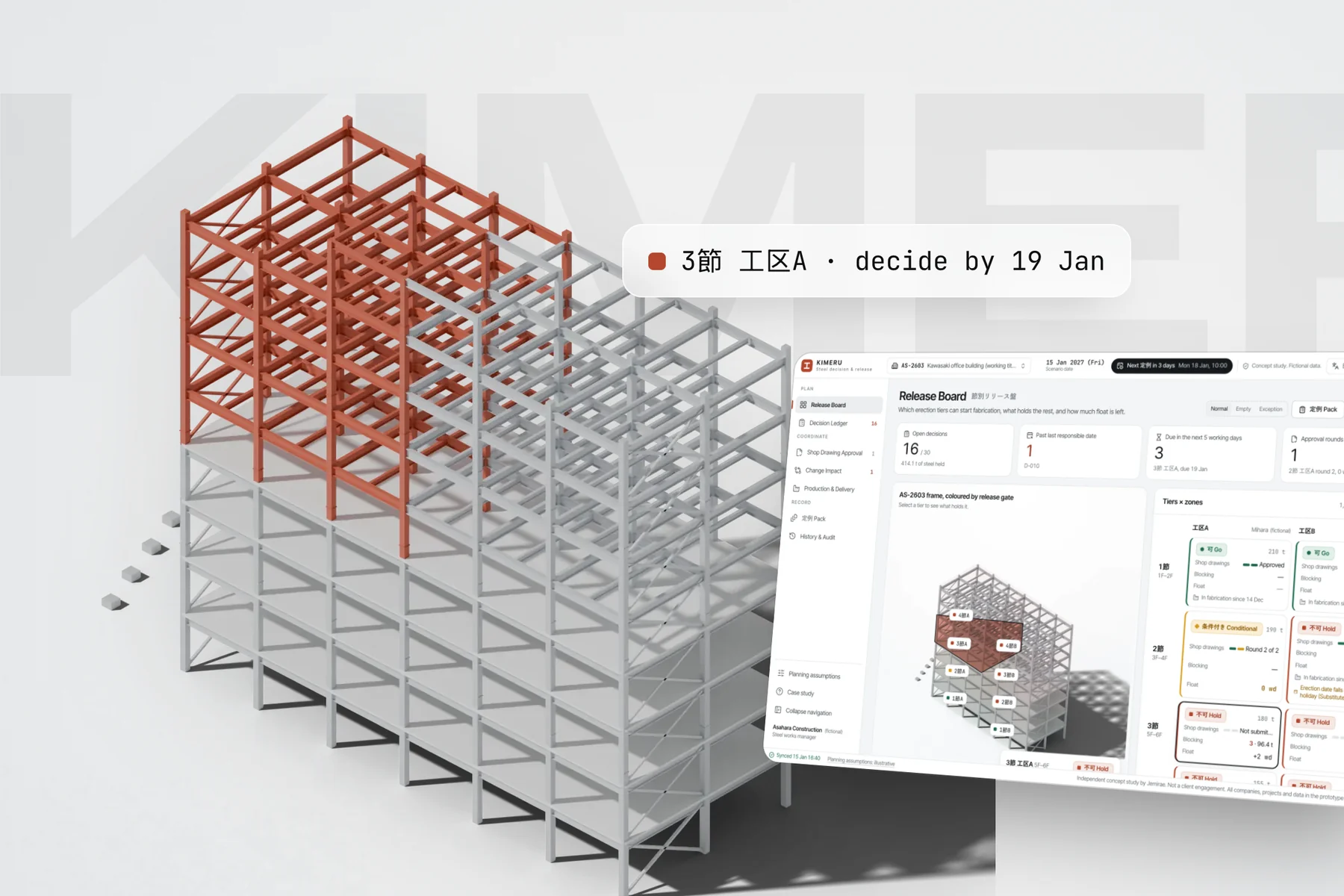
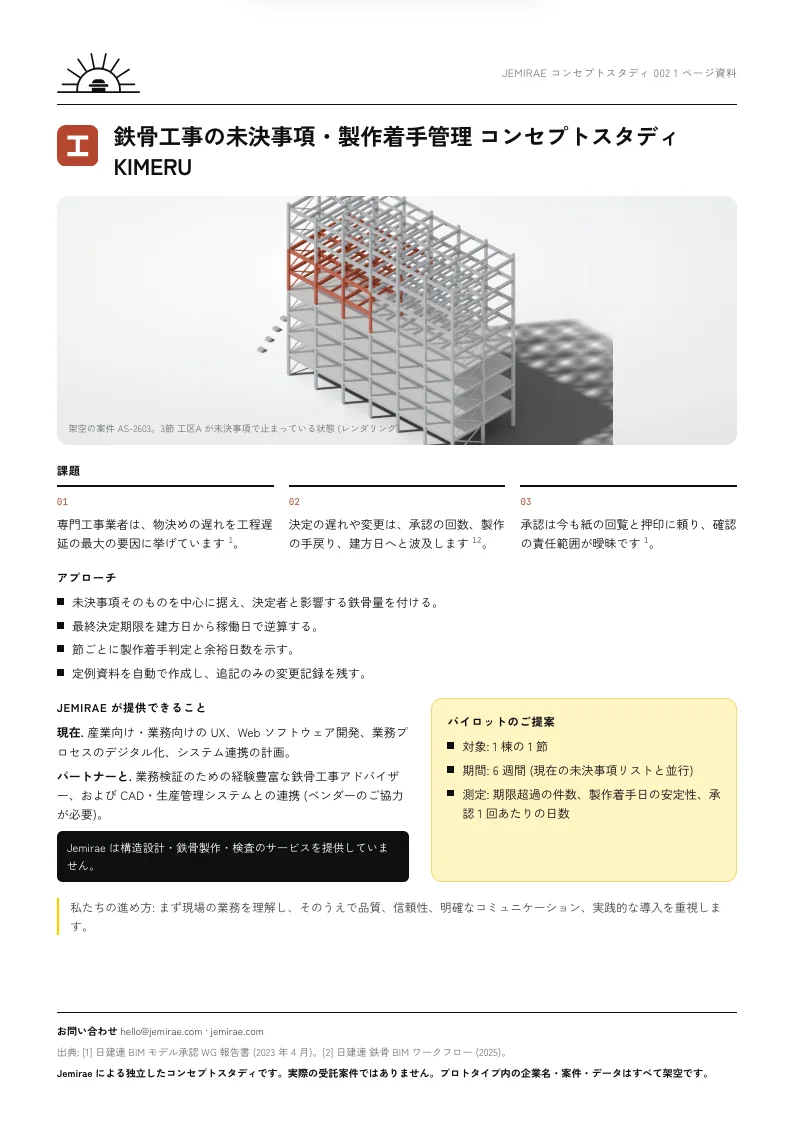
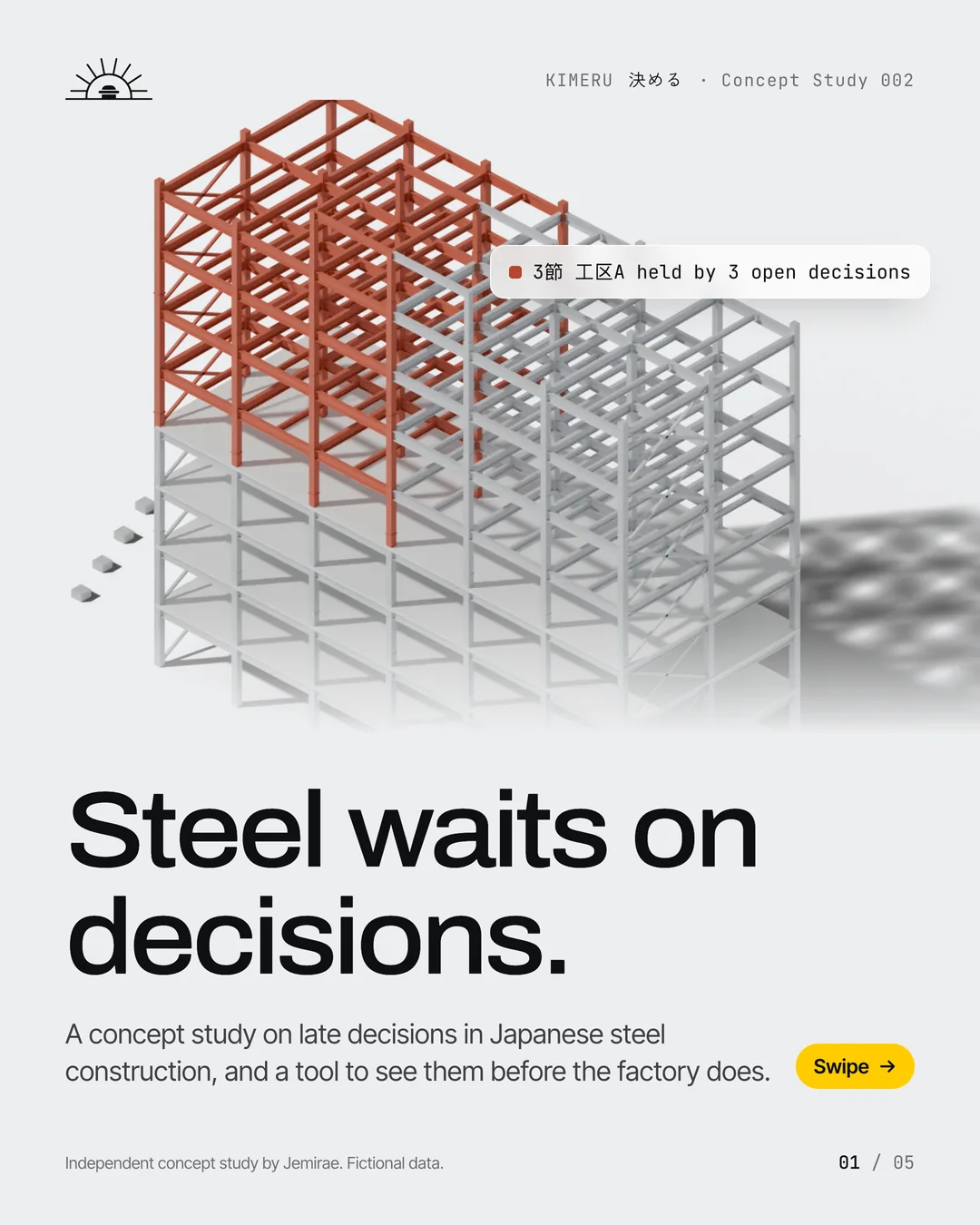
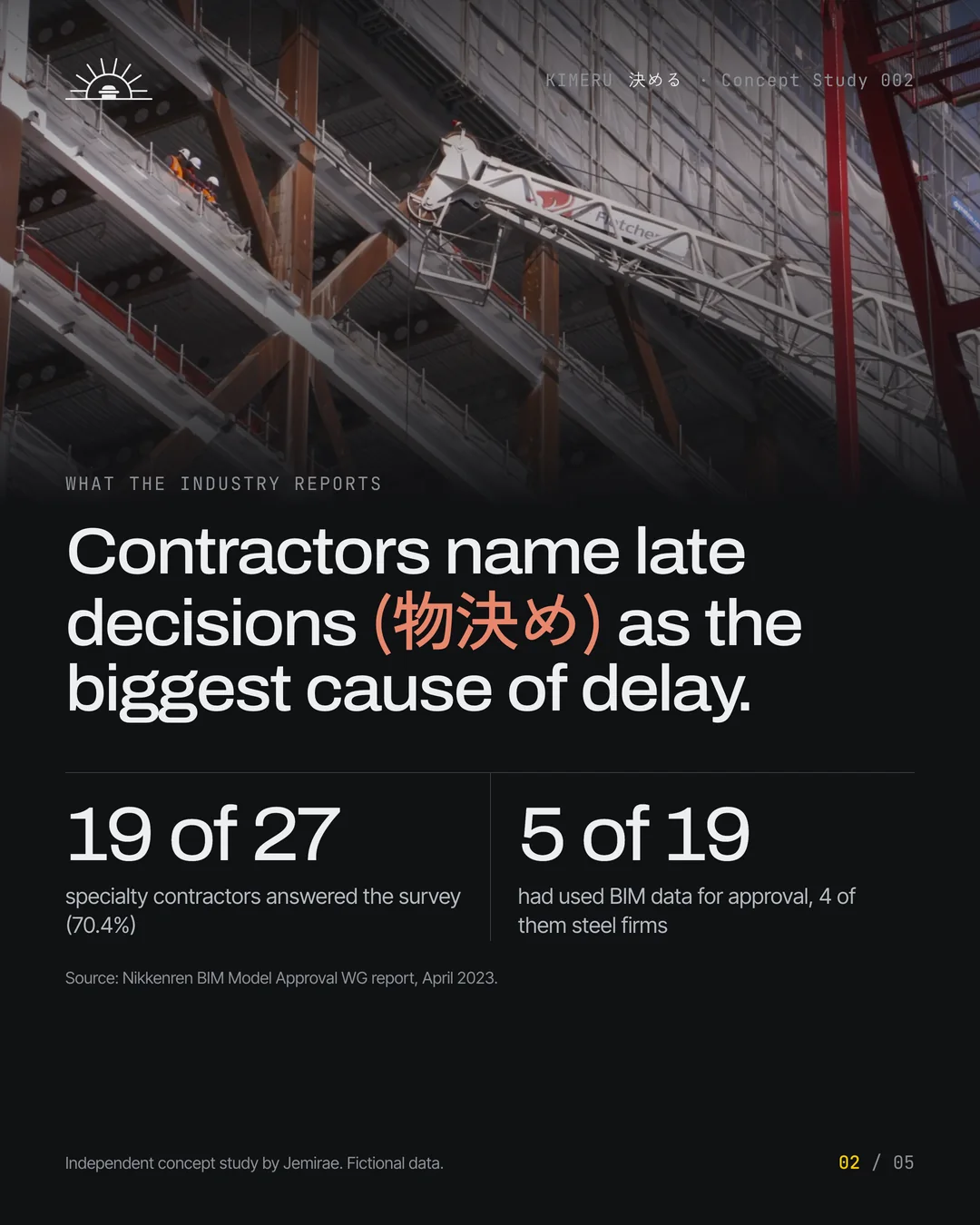
In Japanese steel construction, the industry names late decisions as the biggest cause of delay. KIMERU dates every open decision back from the erection day and shows which steel each one is holding.
- Type
- Independent concept study 002
- Market
- Japan: general contractors, fabricators and their designers
- Built
- November 2026
- Our role
- Research, product design, engineering, 3D, film and print
Independent concept study by Jemirae. Not a client engagement. All companies, projects and data in the prototype are fictional.
Why we made it
Jemirae works between Tokyo and Lagos.
Read more
Before we ask a Japanese firm to trust us with its operations, we want to show how we think about its industry: the research, the workflow, the vocabulary and the standard of the software. Concept studies are how we do that. Each one picks a real, documented problem in a Japanese industry, researches it from published sources, and ends in a working bilingual prototype that a firm can open and judge for itself.
KIMERU (決める, to decide) is the second study, after YOAKE. It looks at steel buildings, where a column cannot be cut until many other companies have answered questions about it.
Steel is built from a chain of decisions
Before a column is cut, a lot has to be settled.
Read more
Where the MEP sleeves pass through each girder. Where the curtain-wall fasteners sit. What the rooftop plant weighs. Each answer comes from a different company, and each feeds the shop drawings (工作図) that the fabricator needs approved before work starts.
Japan's general contractors' federation, Nikkenren, describes delayed decisions as squeezing the steel schedule, and calls this an urgent issue. Its specialty-contractor survey found that firms see late decisions (物決め) as the biggest cause of delay.
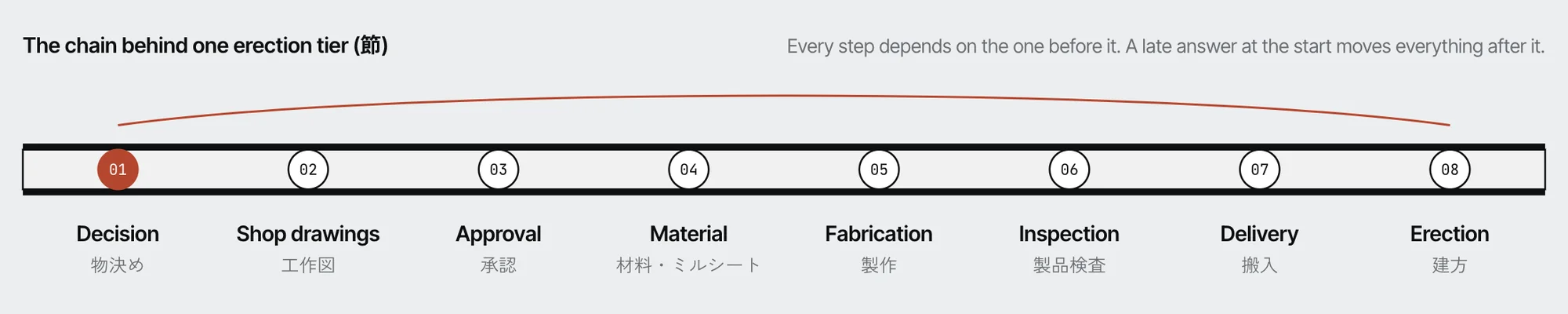
Four parties share that chain: the general contractor, the designer and supervising architect, the fabricator, and the MEP and façade subcontractors. A late answer at the start moves everything after it.
Where the time goes
- Late decisions
Read more
Firms said that while decisions stay late, it makes little difference whether drawings are on paper or in BIM.
- Changes after bidding
Read more
Frequent changes, including additions after bidding, cause rework.
- Late, bulky feedback
Read more
Designers' feedback arrives late and in large volumes.
- Double work
Read more
Steel firms draw 2D fabrication drawings and build 3D models. When decisions are late, this can more than double the effort.
- Paper and stamps
Read more
Approval still relies on paper circulation and stamps, and responsibility for checks is unclear.
- Overloaded factories
Read more
Nikkenren advises contractors to check a new fabricator's quality system and capacity, including whether the factory is overloaded during the fabrication period.
- 5 of 19
- specialty contractors had used BIM data for approval, and 4 of those 5 were steel firms (Nikkenren, April 2023)
- More than 3×
- the normal budget and schedule, when one steel firm's project-wide BIM attempt fell back to 2D (same report)
- 14 days
- coordination cycle on a published design-build steel factory project of about 6,000 t (Nikkenren, 2025)
Every figure on this page keeps the meaning given in its Nikkenren source.
Read more
The survey had 19 responses out of 27 specialty contractors (70.4%). Its recommendation is to fix and freeze decisions early, and it adds that tools cannot fix a broken workflow.
Nikkenren's 2025 steel-frame BIM workflow lists five steps after any change: identify the scope, cost and schedule impact; pause fabrication or construction if needed; revise drawings and models; obtain re-approval; and record the change history.
The 6,000 t factory project linked three fabricators across four plants in one shared workflow and reported no fabrication errors or missing pieces. It named the shortage of BIM modellers as its biggest constraint. It is a published industry example and has no connection to KIMERU.
What we believe, to be validated
These are hypotheses for a pilot to test. They are not findings.
- Spreadsheets cut off from fabrication
Read more
Many teams track open decisions in spreadsheets that are not connected to fabrication dates.
- The decision is not the core object
Read more
No common tool makes the decision itself, with its last responsible date and the tonnage it holds, the core object.
- Facts change meetings
Read more
Showing the time each party held a drawing package, factually, changes how weekly 定例 meetings run.
- Trucking limits (a consideration only)
Read more
Delivery planning will increasingly need to respect trucking constraints. This reflects Japan's logistics labour situation in general and has not been verified for steel.
The idea: a ledger of decisions, dated from erection
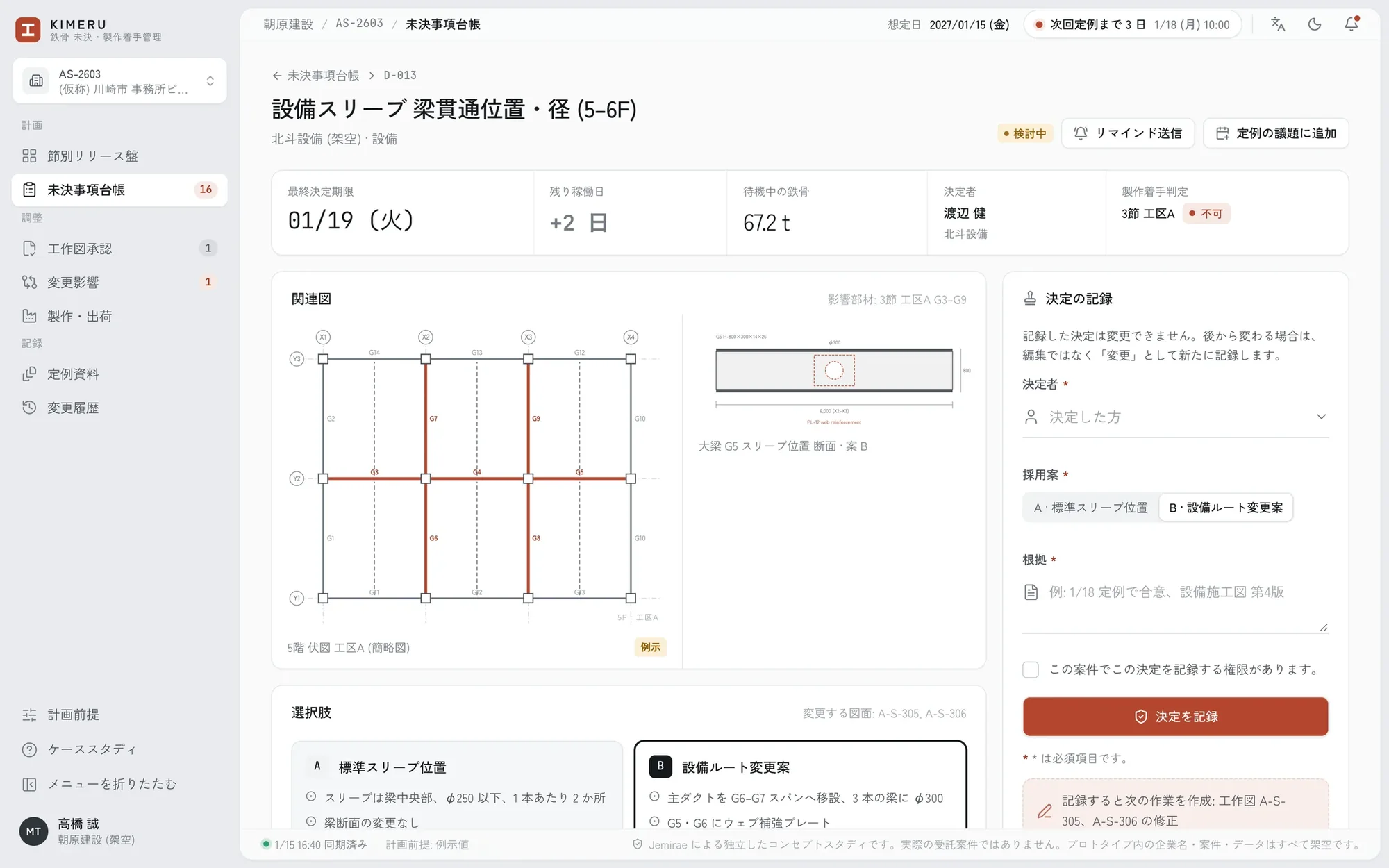
KIMERU keeps one decision ledger shared by the general contractor, designer, fabricator and subcontractors.
Read more
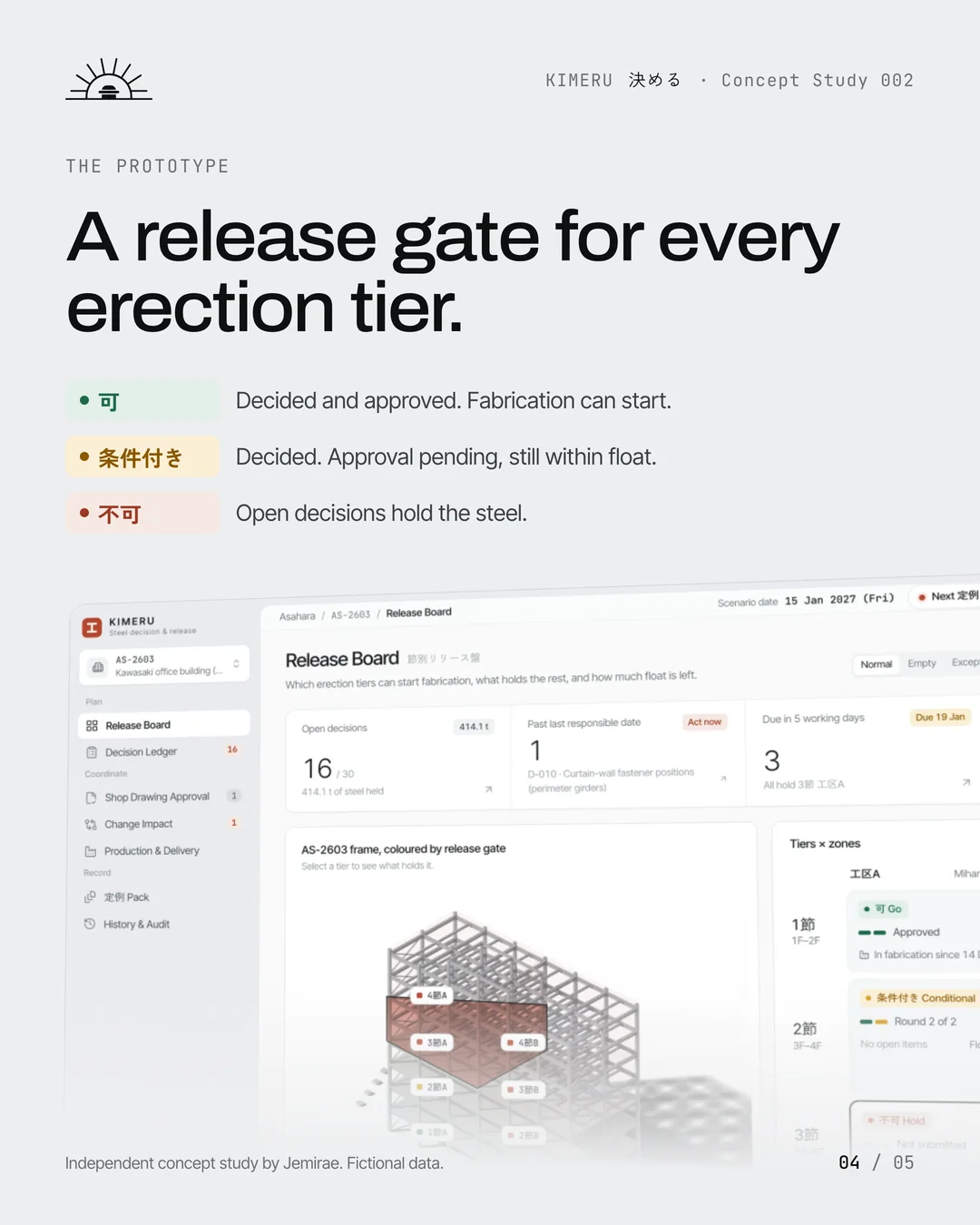
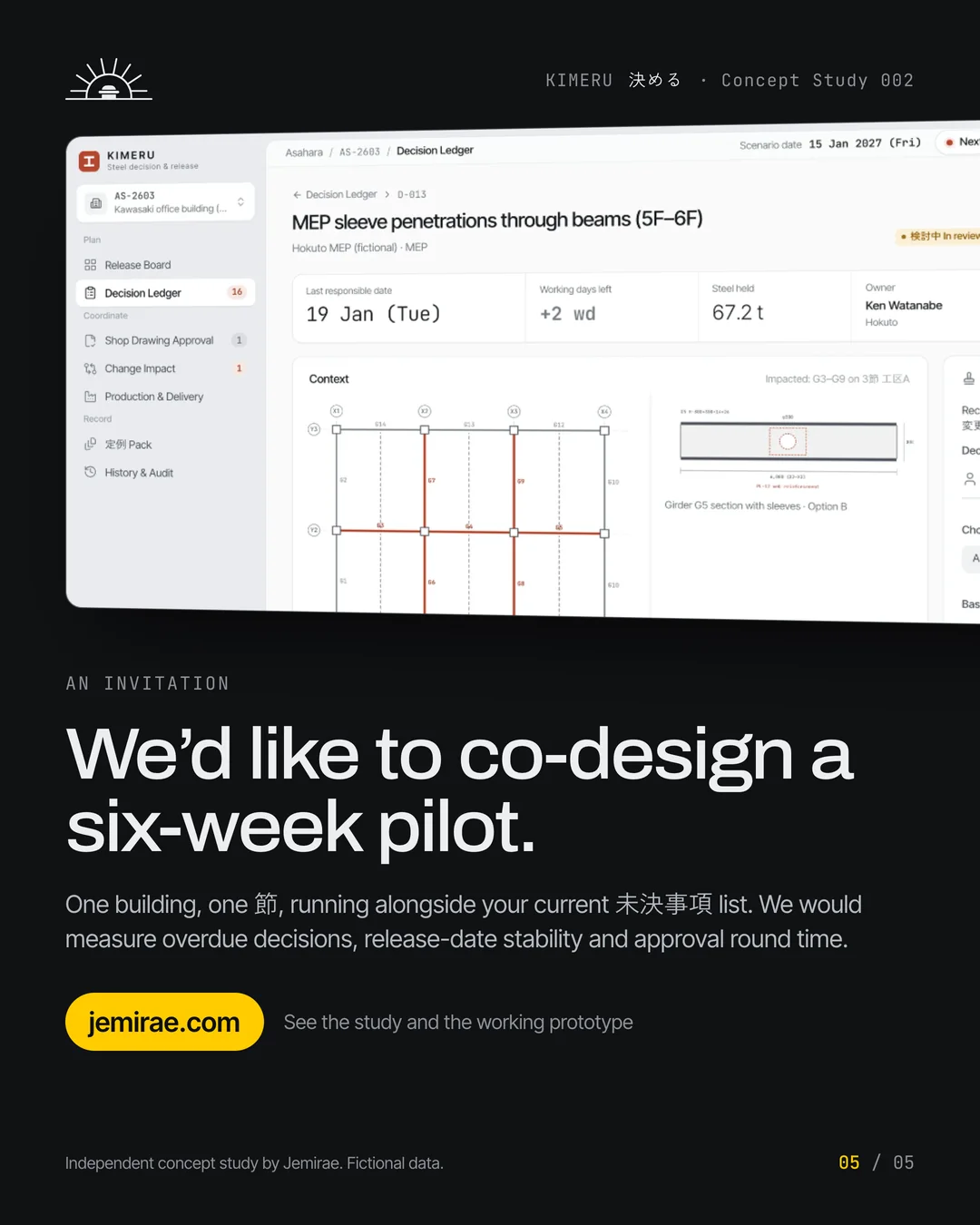
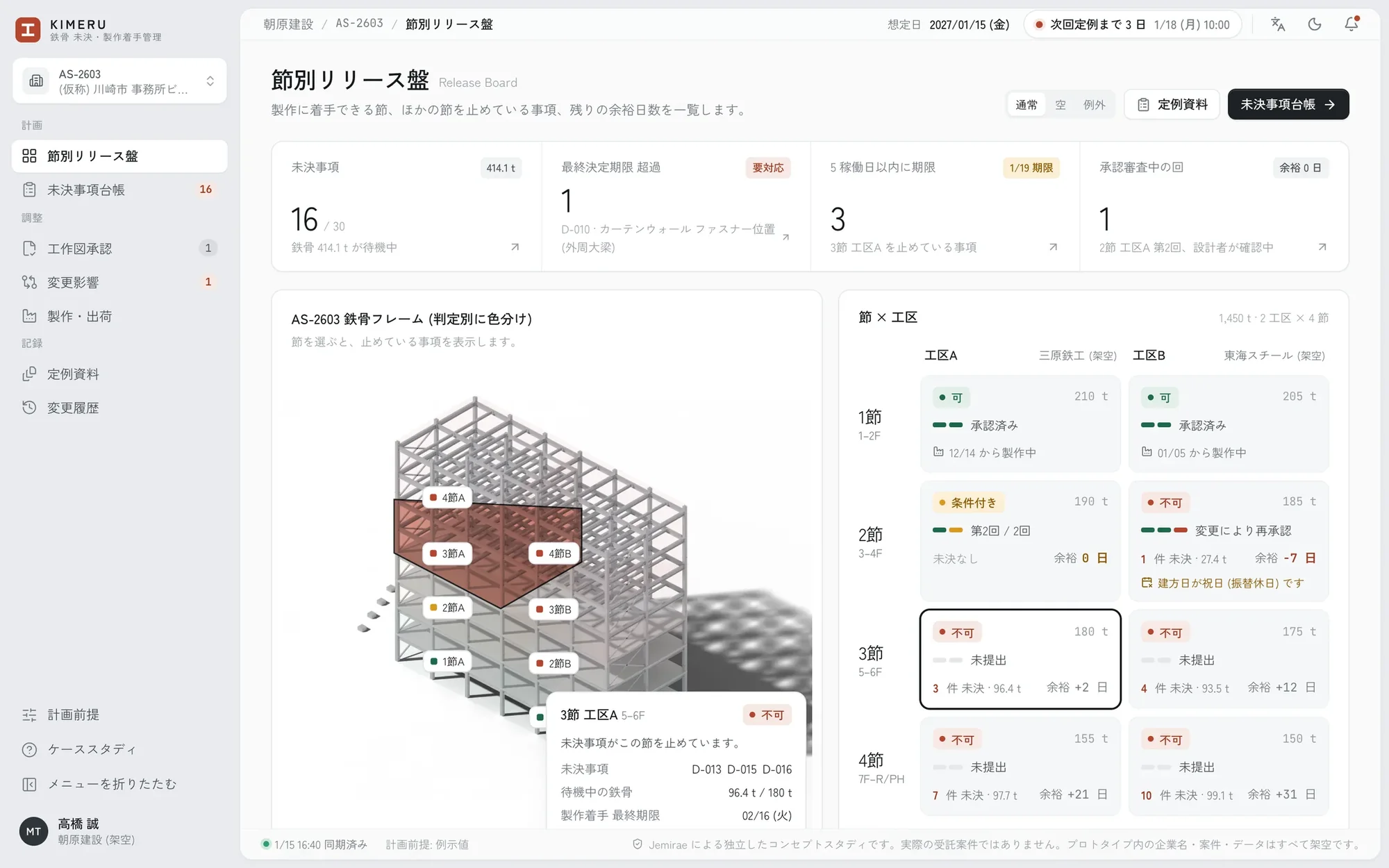
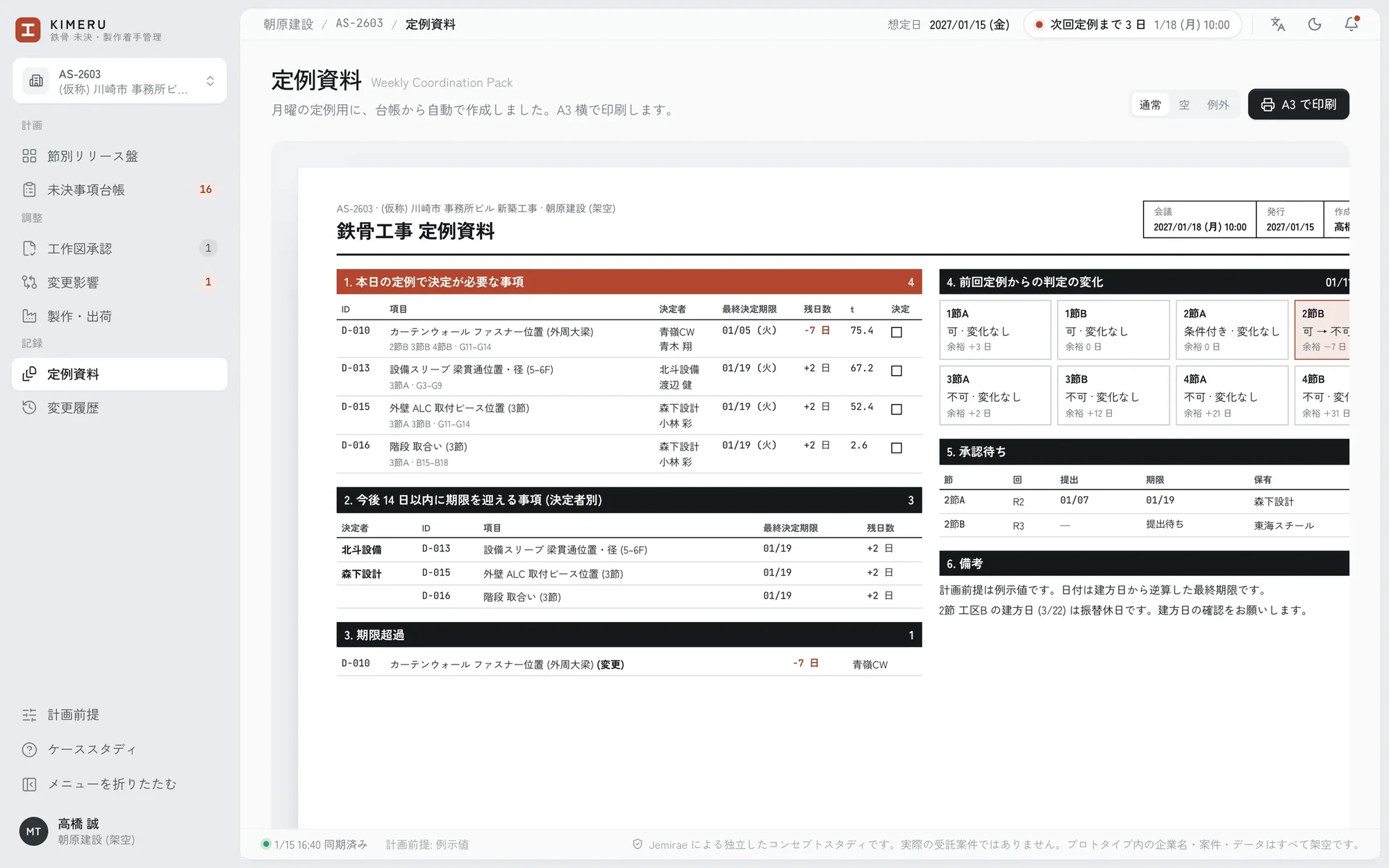
Each open item has an owner, a last responsible date and the tonnage it is holding. It takes in what already exists, the erection schedule (建方工程), the member list from detailing CAD and the shop drawing approval logs, and gives back release gates per erection tier, a weekly meeting pack and a change record.
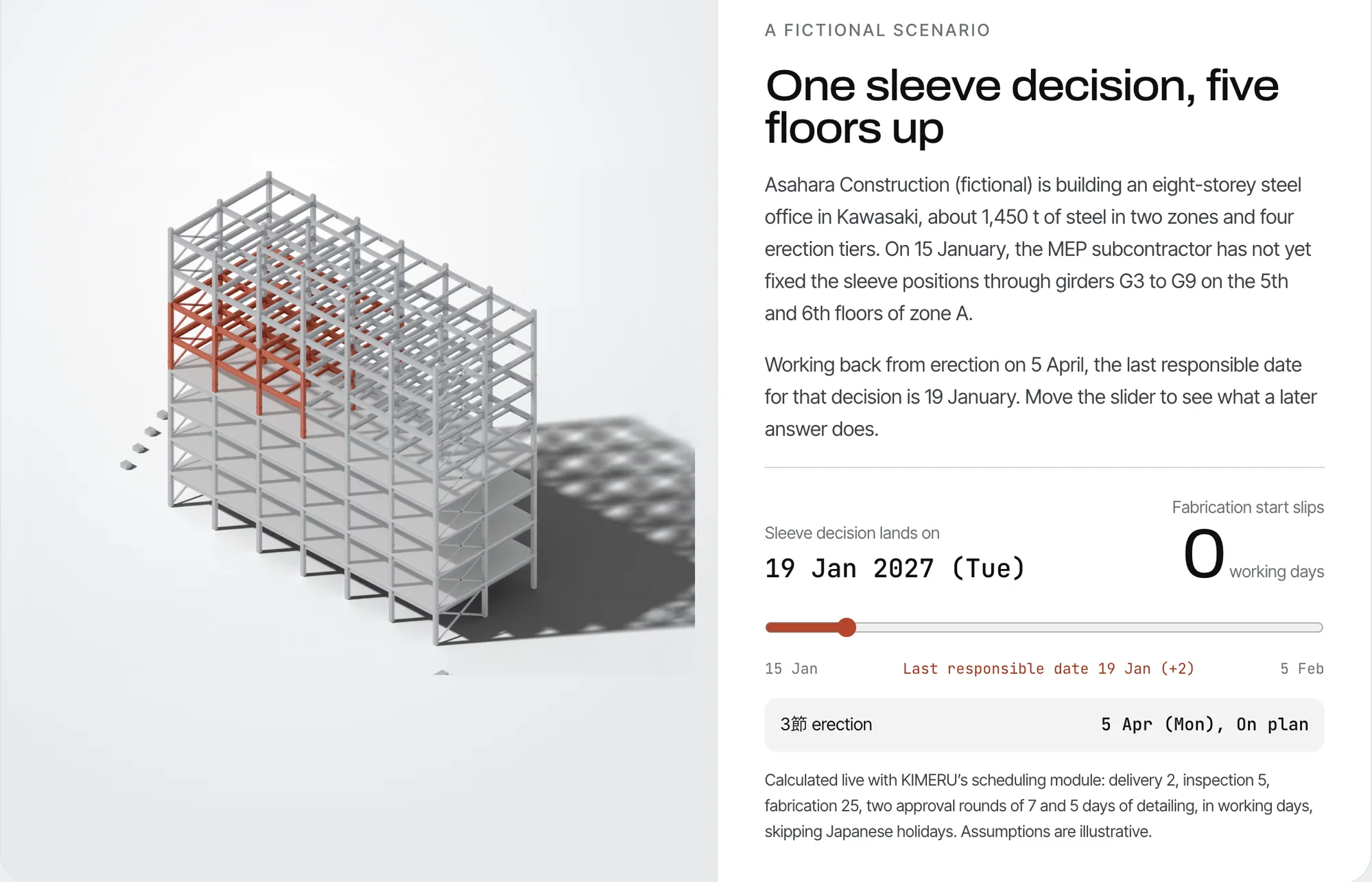
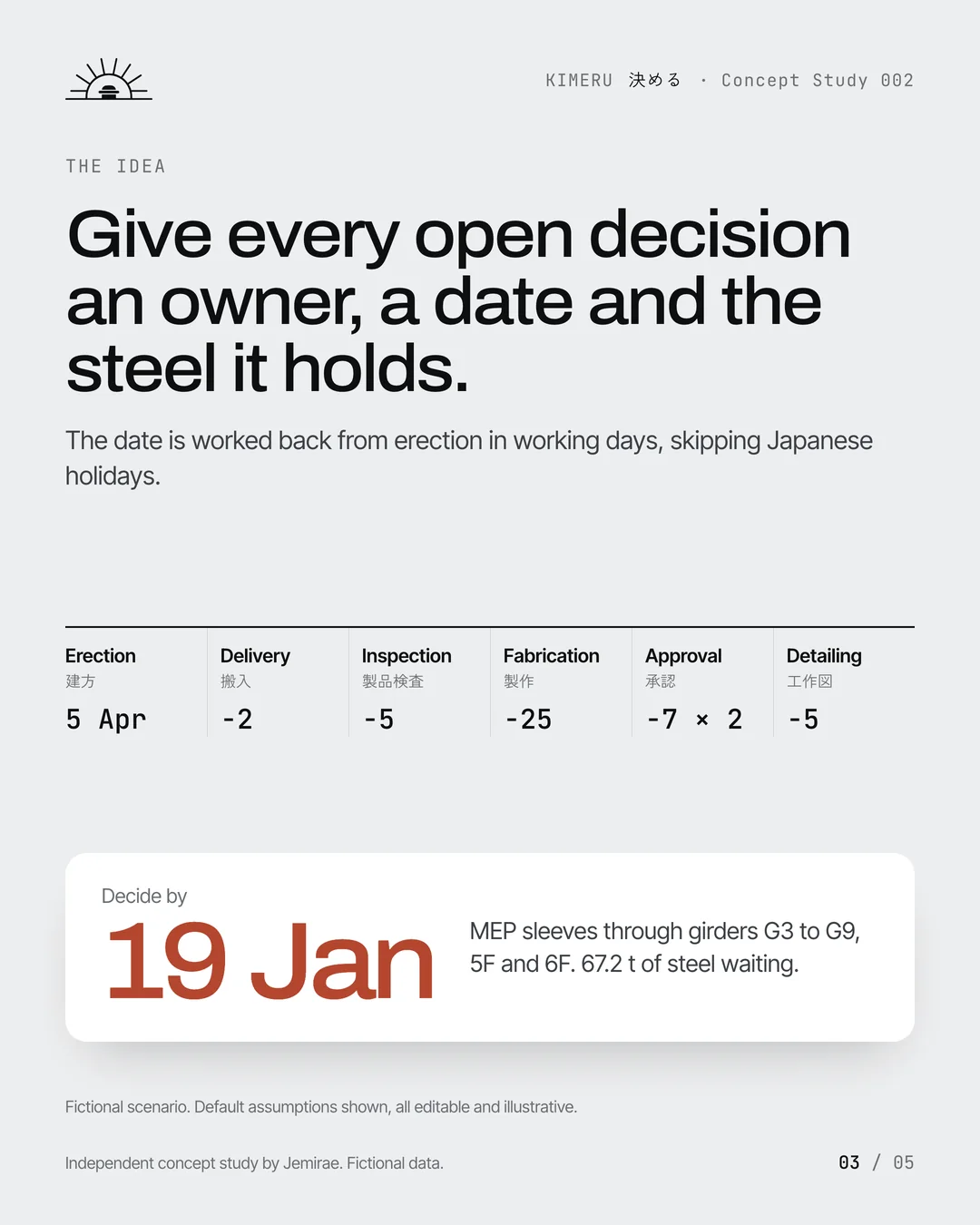
The last responsible date is calculated backwards from erection, in working days, skipping Japanese holidays: delivery 2, inspection 5, fabrication 25, two approval rounds of 7, and 5 days of detailing. Every value is editable in the prototype and labelled illustrative.
Integrations with fabricator production systems, IFC or CSV member lists and holiday calendars are conceptual. Connecting to specific CAD or production systems needs each vendor's cooperation.
01 · Day 0
Erection 建方
The date everything is worked back from.
02 · −2 working days
Delivery 搬入
03 · −5 working days
Inspection 製品検査
04 · −25 working days
Fabrication 製作
05 · −7 × 2 rounds
Approval 承認
Two approval rounds of seven working days.
06 · −5 for detailing
Decide by 最終決定期限
The last responsible date for the decision.
One sleeve decision, five floors up
The prototype follows one fictional project through one week.
Read more
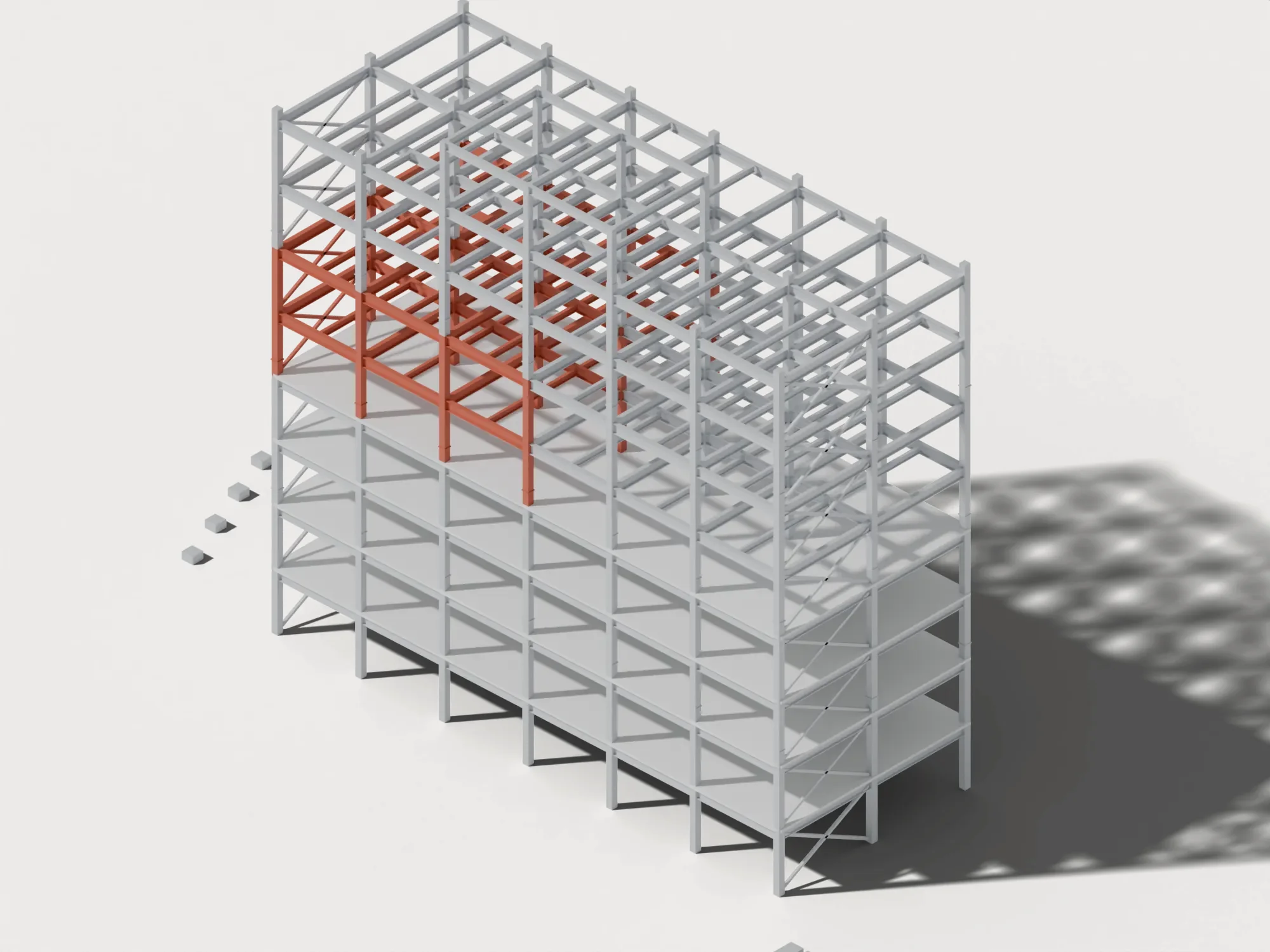
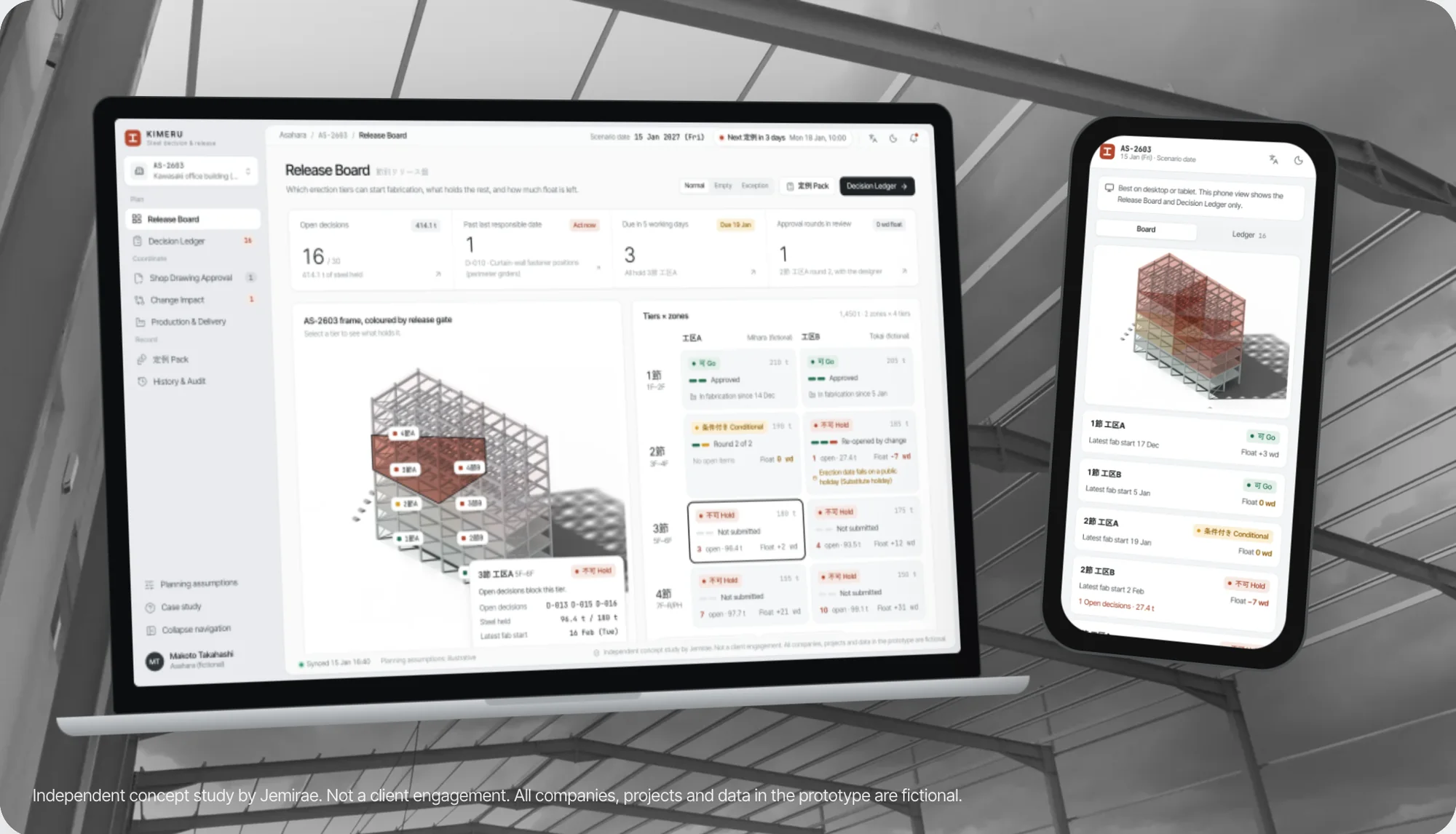
Asahara Construction (fictional) is building an eight-storey steel office in Kawasaki, about 1,450 t of steel in two zones and four erection tiers. On 15 January 2027 the MEP subcontractor has not yet fixed the sleeve positions through girders G3 to G9 on the 5th and 6th floors of zone A.
Working back from erection on 5 April, the last responsible date for that decision is 19 January. Every number on every screen comes from the same seed data and the same scheduling rules, so the Release Board, the ledger, the meeting pack and the history all tell the same story.
Eight connected screens
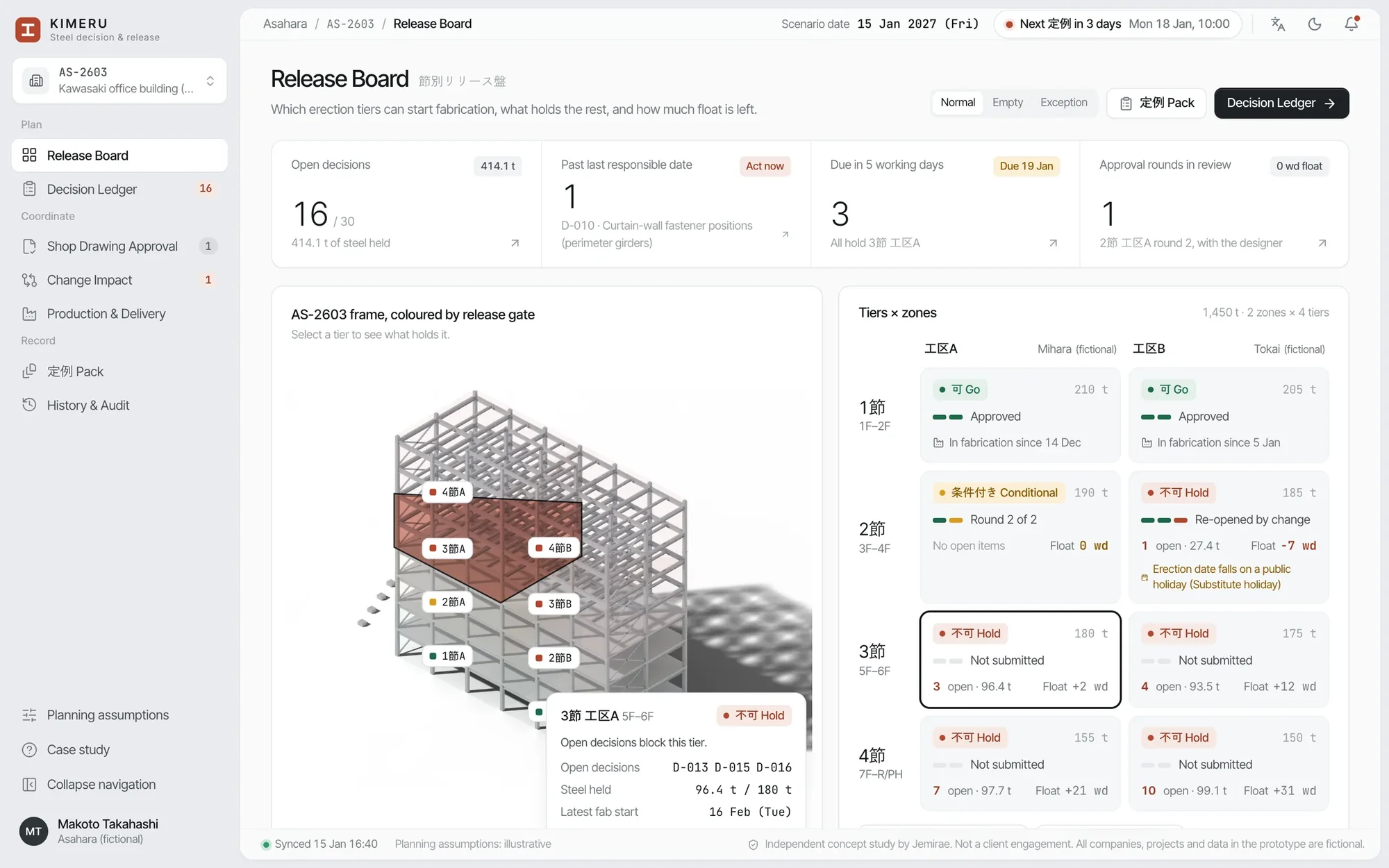
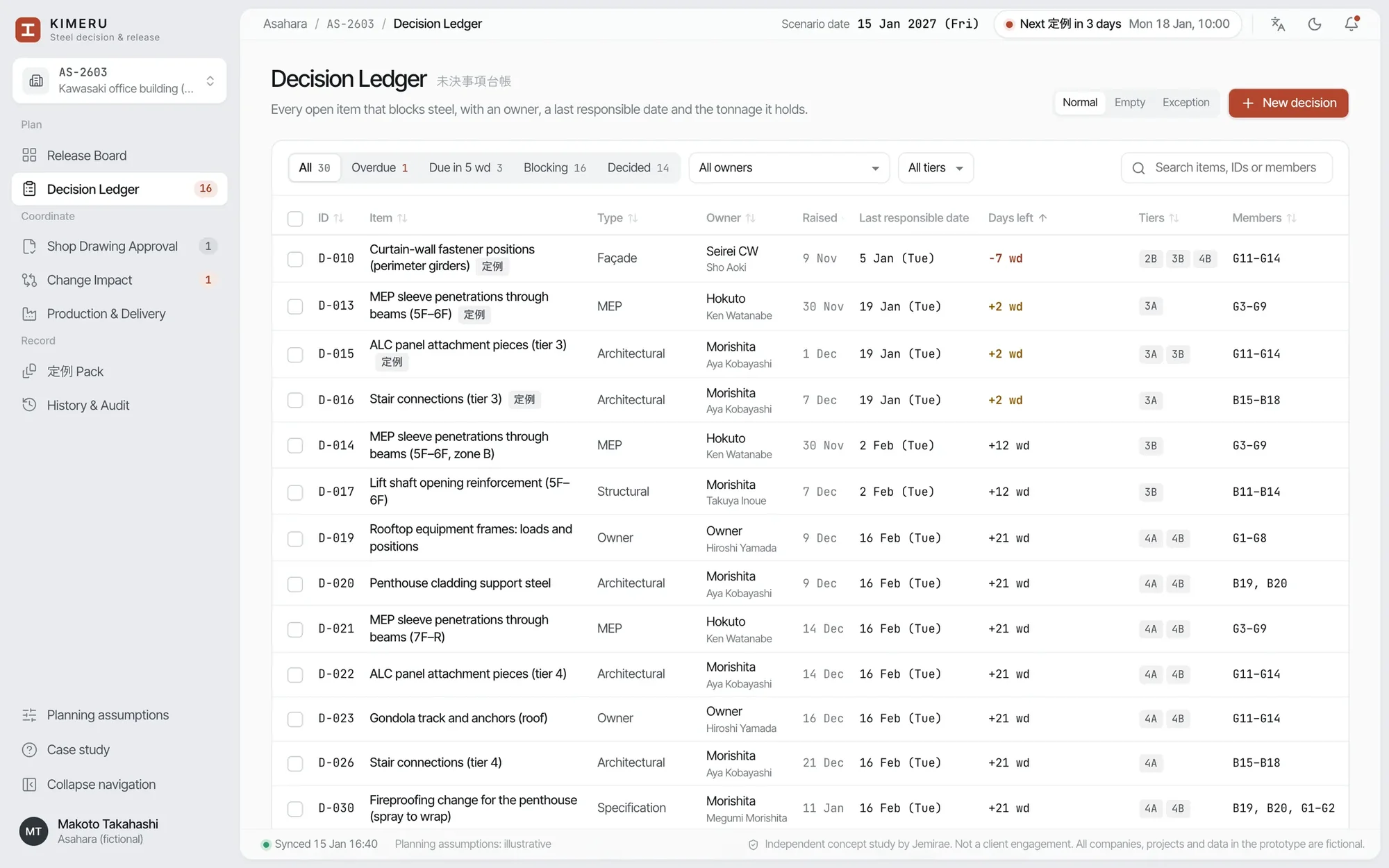
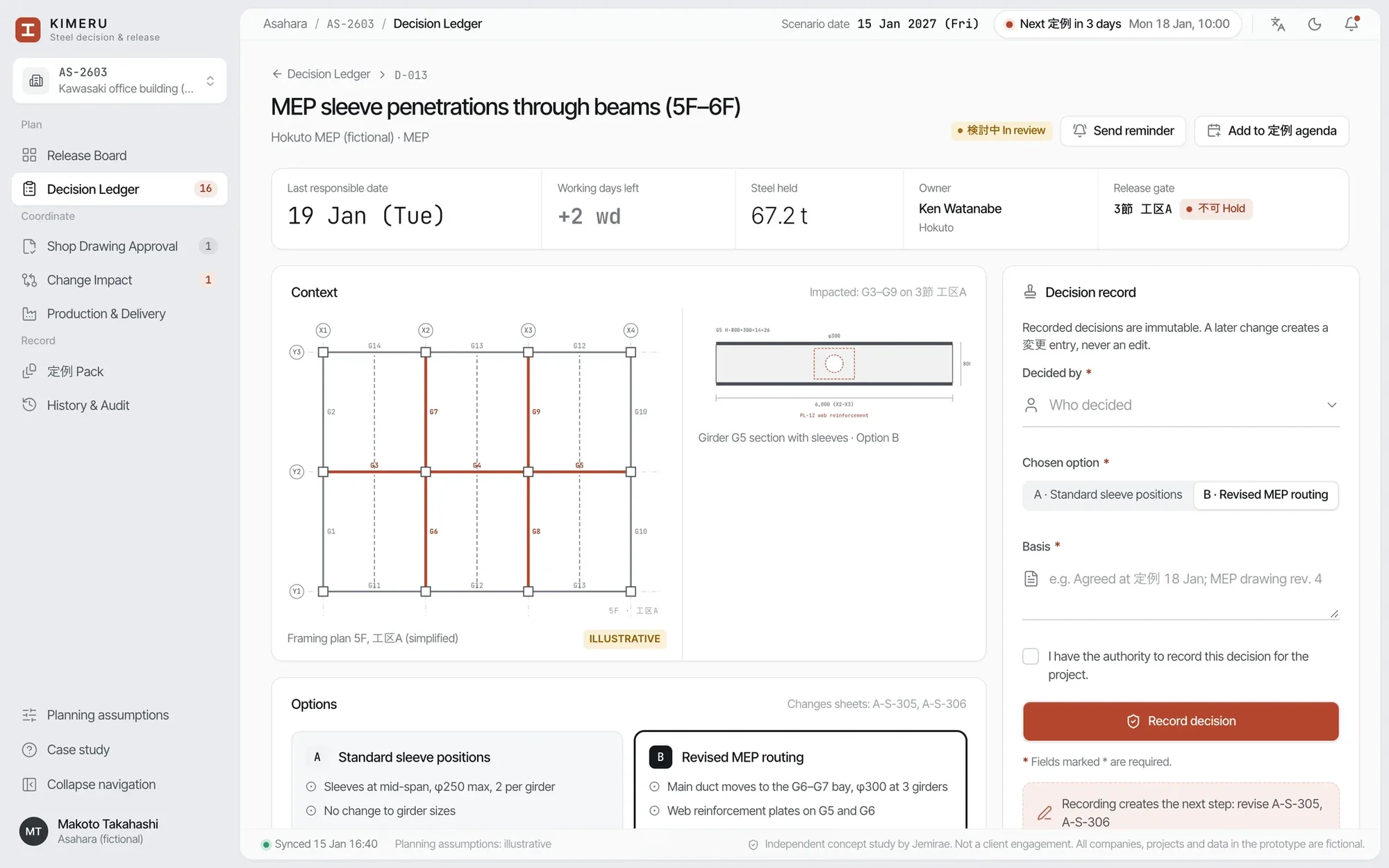
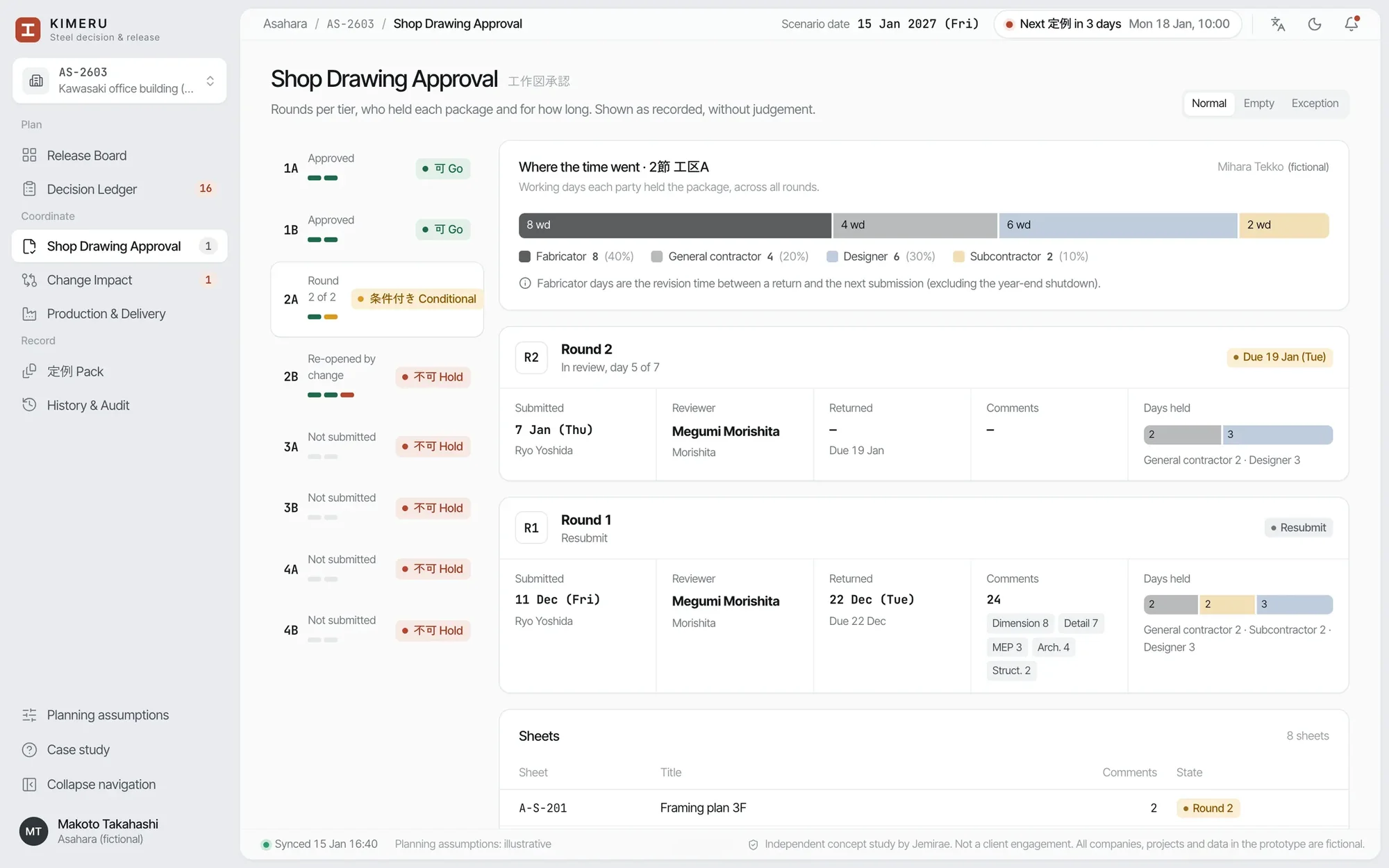
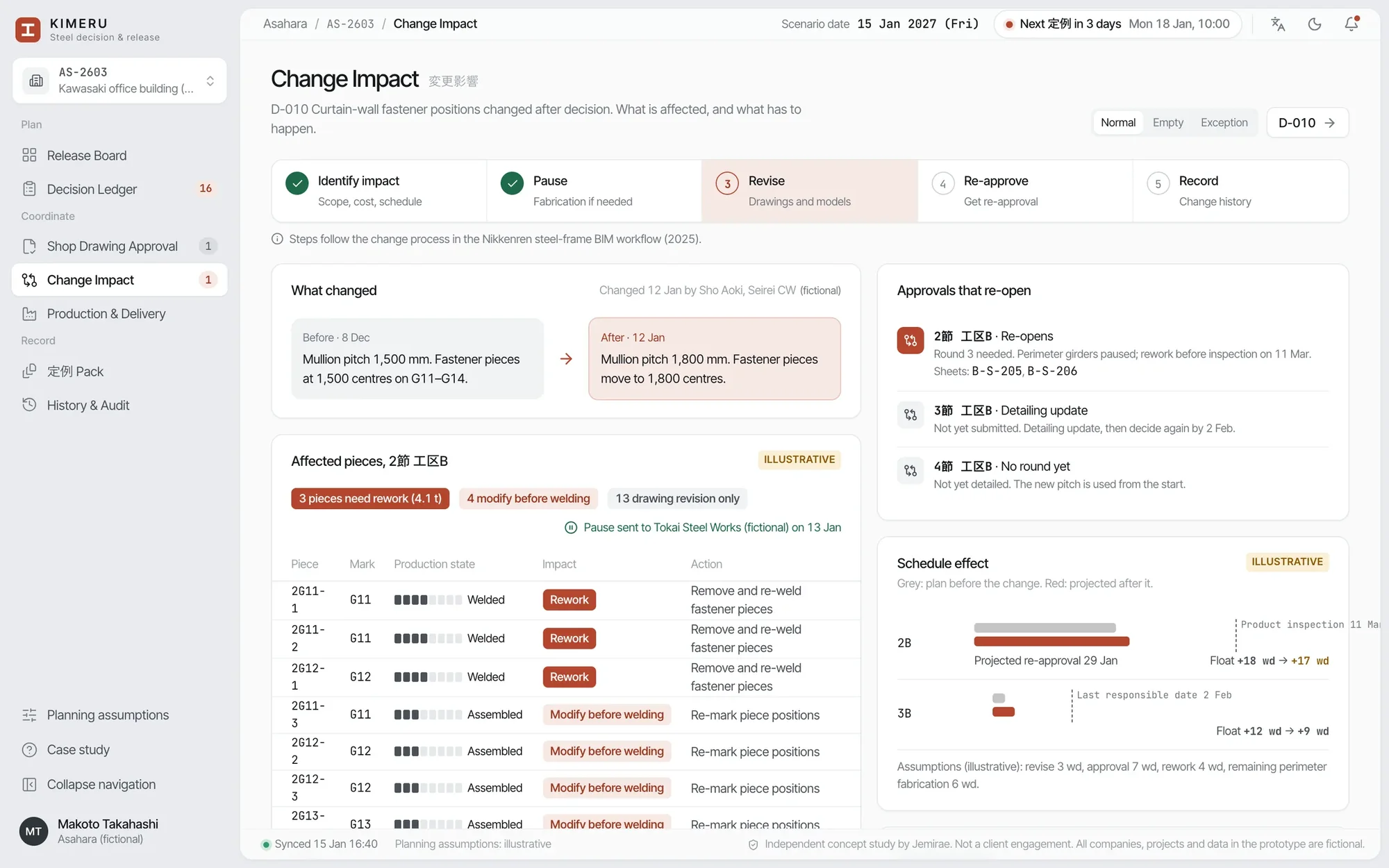
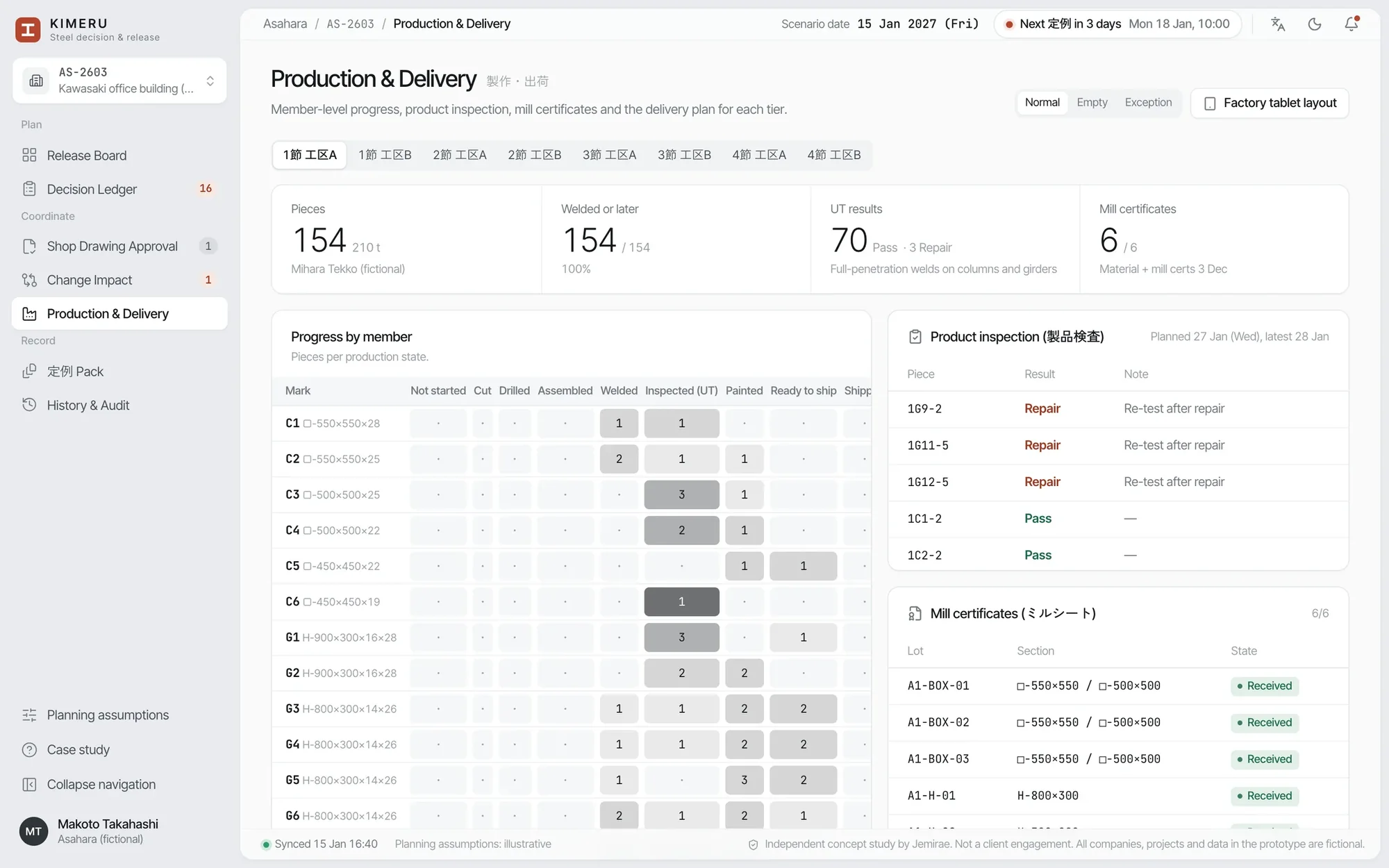
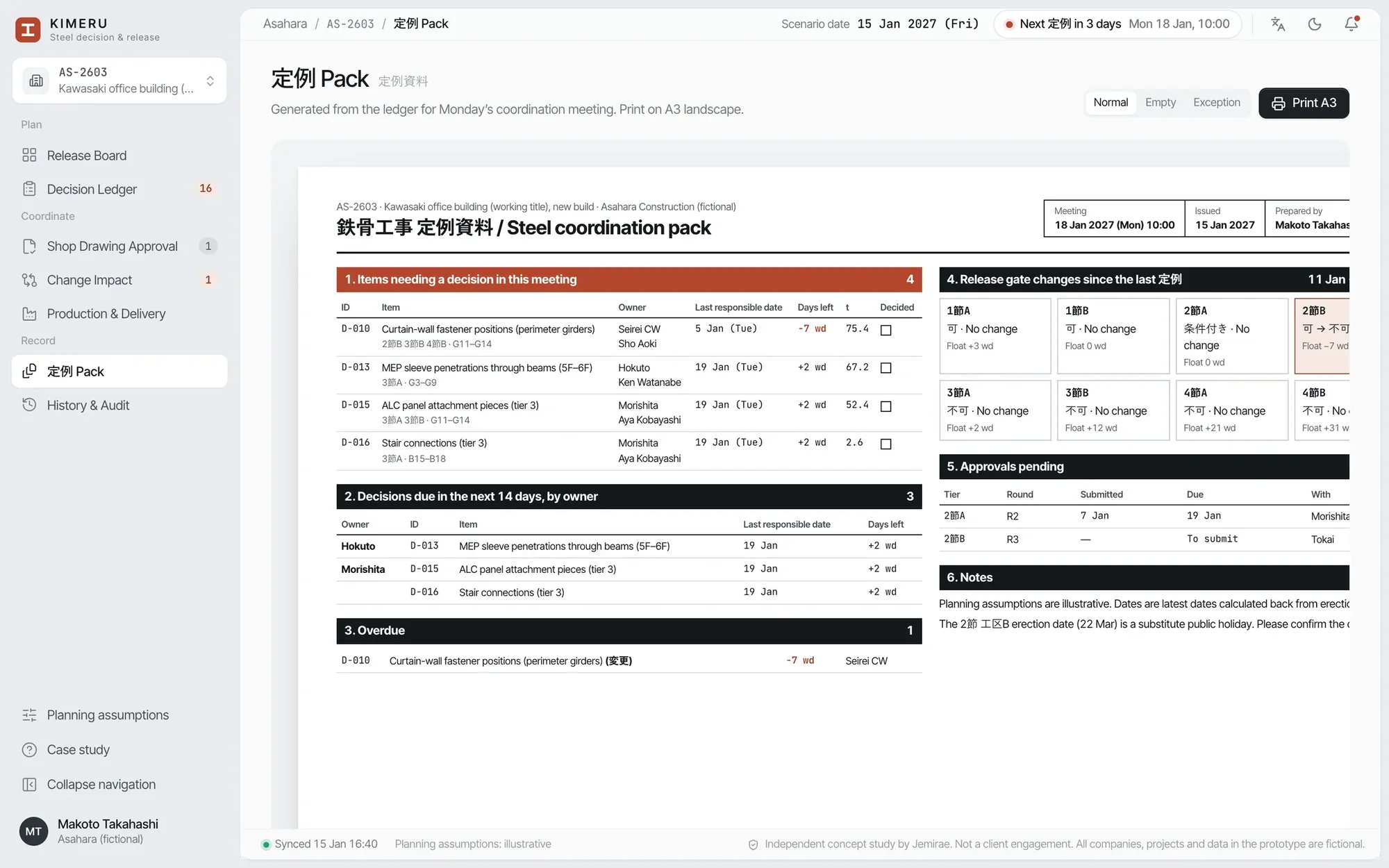
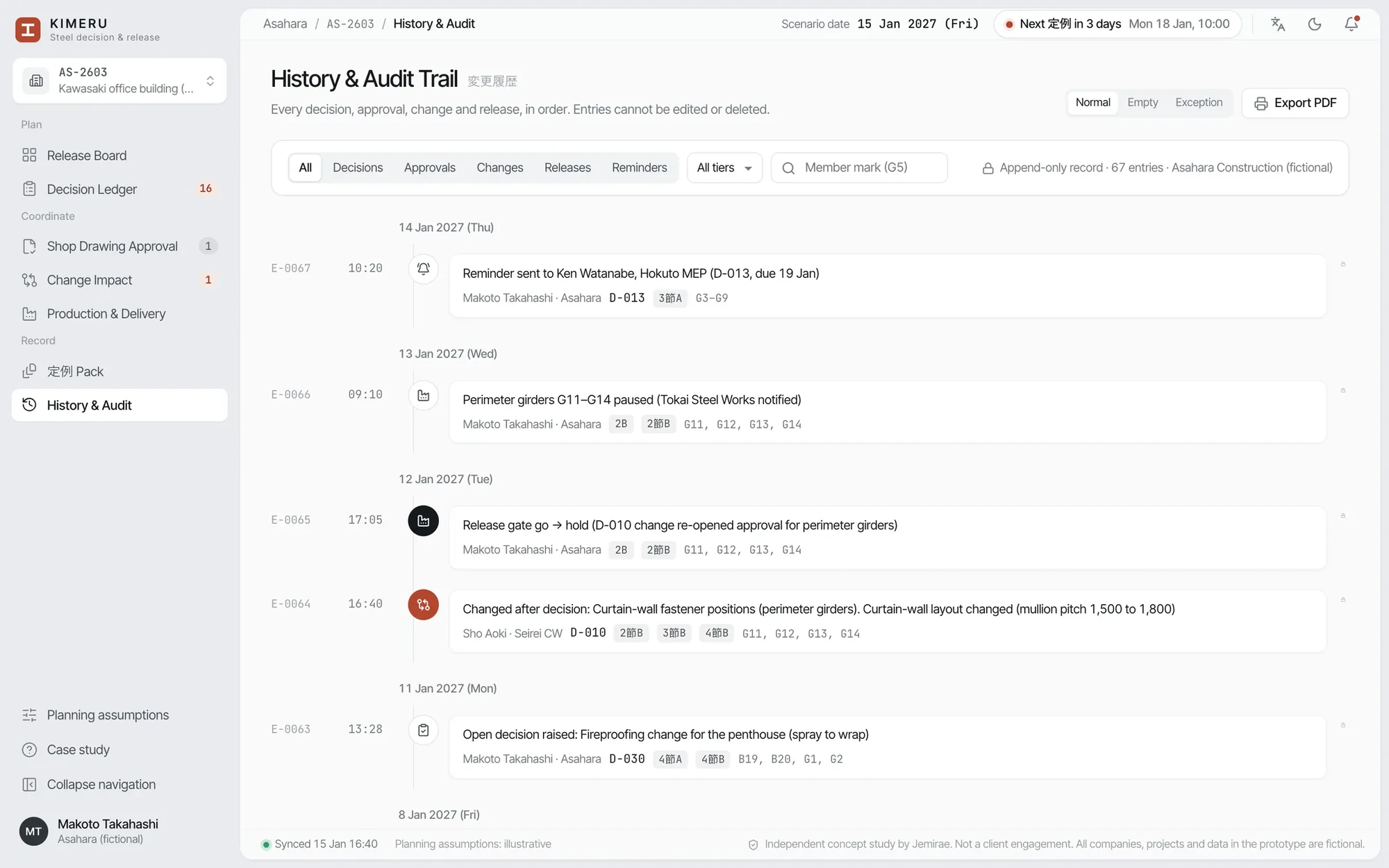
Watch the walkthrough
For the office, the factory and the site
Design and engineering decisions
One colour carries the meaning.
Read more
Red-oxide, the colour of steel primer, marks anything held by a decision, on the 3D frame, on the tier cards and on the chips. Everything else stays in quiet greys, so the eye goes straight to what is blocking the factory.
Japanese terms are first-class, not translations. Screens use the words a site team uses, such as 節, 工区, 工作図 and 定例, with English beside them, and the whole interface switches between English and Japanese.
The interface follows the calm density of Japanese industrial software: regular-weight titles, borderless tinted status chips, a KPI strip and tables built for scanning. The layout is a navigation rail around a white working sheet, like a drawing on a desk.
Under it is real code. Vite, React and TypeScript, with Zustand for state and TanStack Table for the data grids. Tests in Vitest cover the back-scheduling maths, the consistency of the seed data and parity between the English and Japanese text. The building is rendered in Blender, and the app colours the same frame by projecting it with the same camera maths.
Where KIMERU sits
Strong tools already exist on each side of the process.
Read more
KIMERU is a coordination layer for the space between them: the open decision, its date and the steel it holds. Product names belong to their owners and are cited for context only.
- Tekla PowerFab (Trimble)
Read more
Fabricator-side estimating, project management with drawing control and change management, purchasing, inventory, production control and shipping. KIMERU complements it: production status could feed the release gates.
- S/F REAL4 (データロジック)
Read more
3D steel CAD generating general, detail and processing drawings and NC data. KIMERU connects to it: member lists from detailing CAD become the members a decision holds.
- ANDPAD
Read more
Construction management: drawings, ordering and inspection. KIMERU stays narrow on steel decisions and release.
- Autodesk Construction Cloud
Read more
Available in Japan since April 2022. Approval logs and documents could be referenced from the ledger.
- Procore
Read more
An international construction management platform with submittals. A similar role for teams that use it.
- Excel and paper
Read more
Common practice for open-item lists and approval circulation. KIMERU replaces the spreadsheet list, not the people or the meeting.
What we expect it to change
These are expected benefits for a pilot to test. None of them is a measured result.
- Decisions surfaced before they block fabrication
Read more
Each open item carries a date worked back from erection, so the list shows what matters this week.
- A visible float per tier
Read more
Everyone sees how many working days are left before the factory would have to wait.
- Faster, fairer 定例
Read more
The pack is generated from the ledger, and time held is shown as recorded, without blame.
- A complete change record
Read more
Each change carries its impact, the pause, the revision, the re-approval and the history.
Posters, brief and launch material
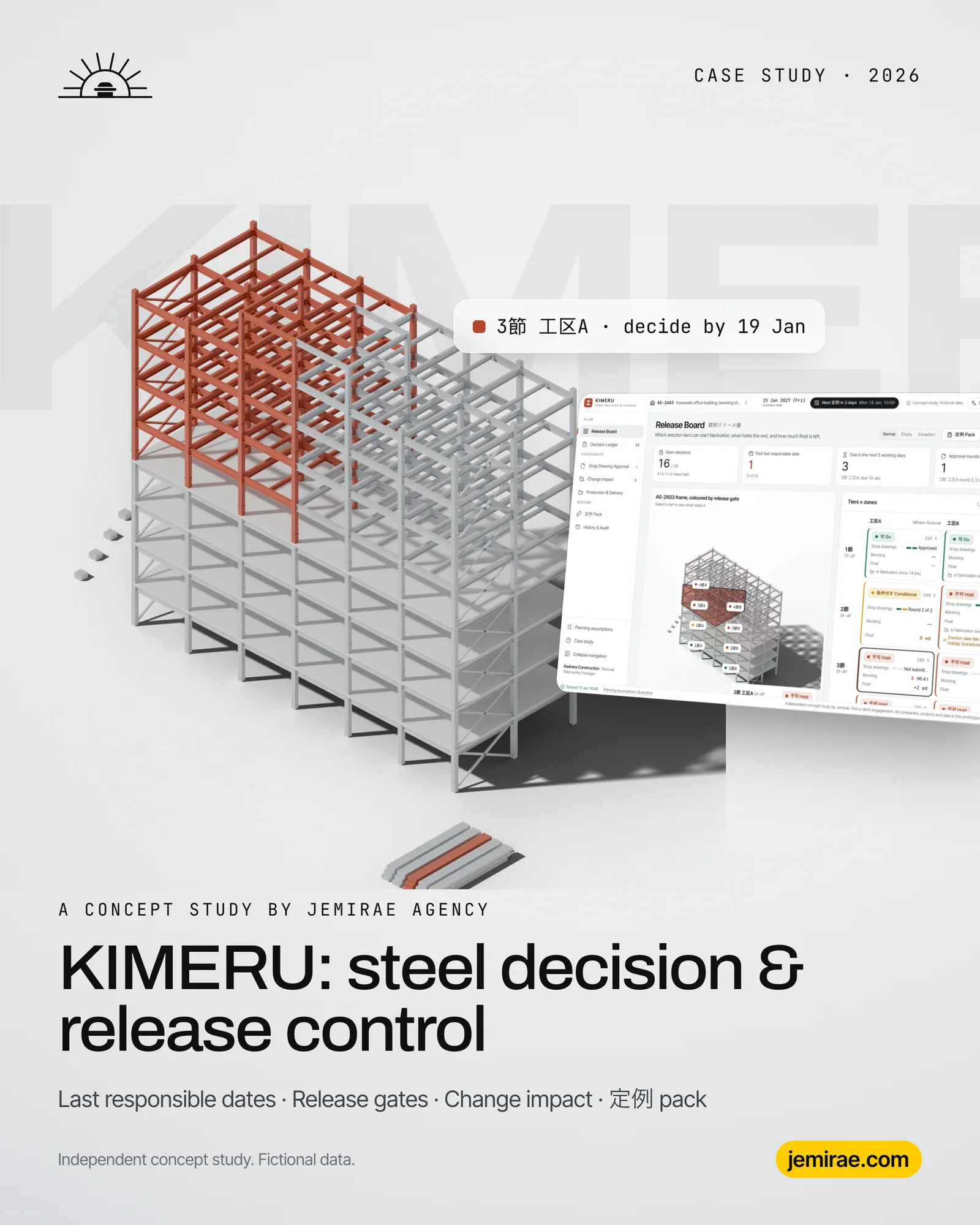
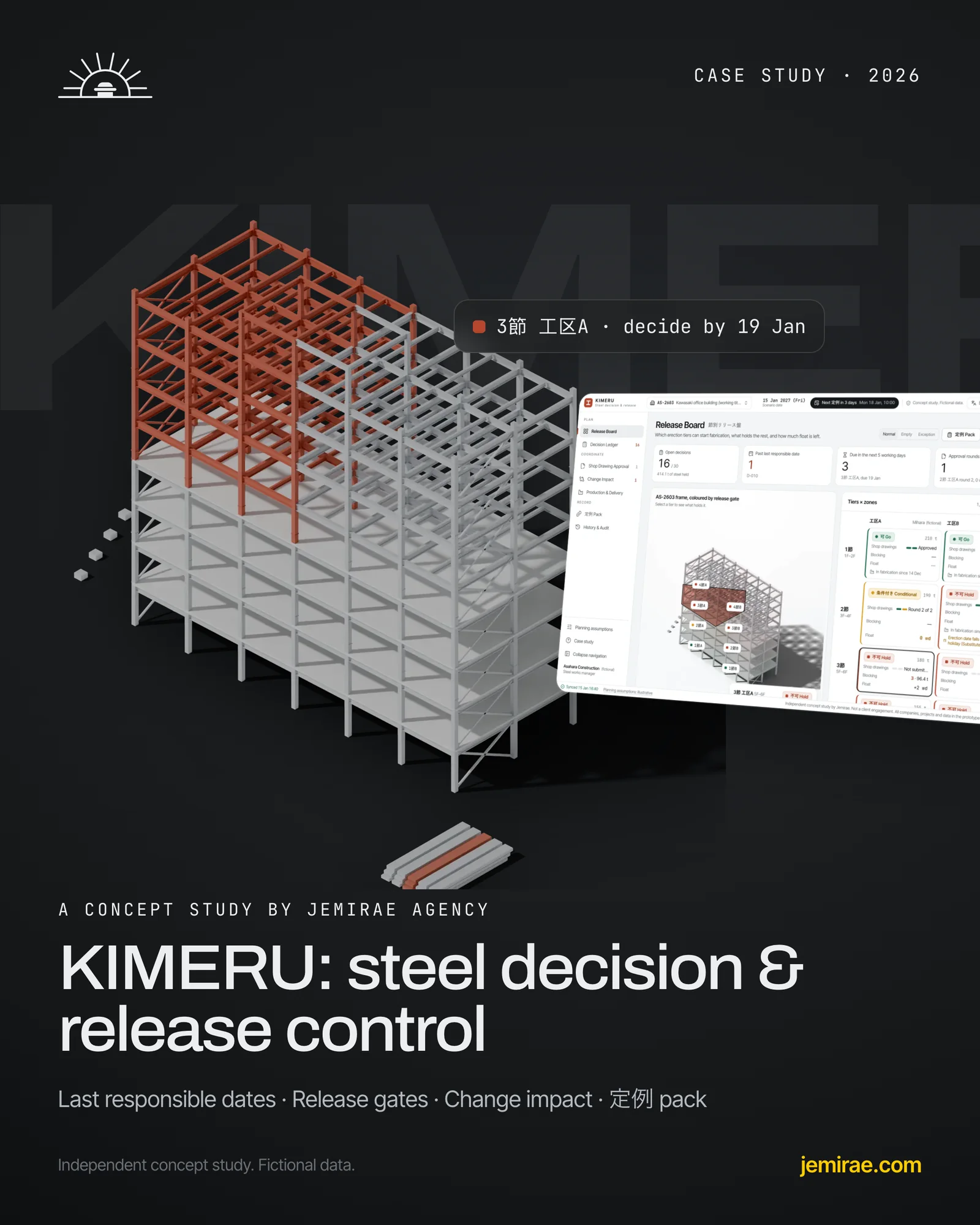
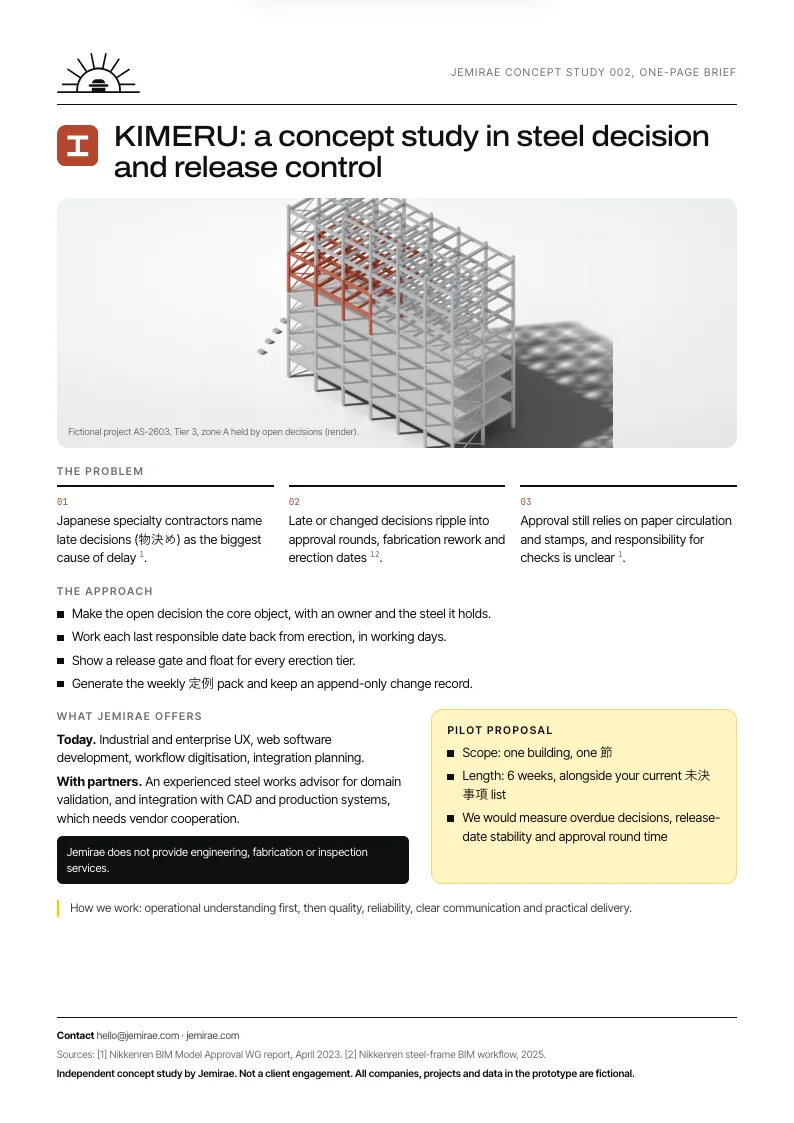
Each study ships with the material a firm needs to discuss it internally: posters, a one-page brief in English and Japanese, and a LinkedIn carousel.
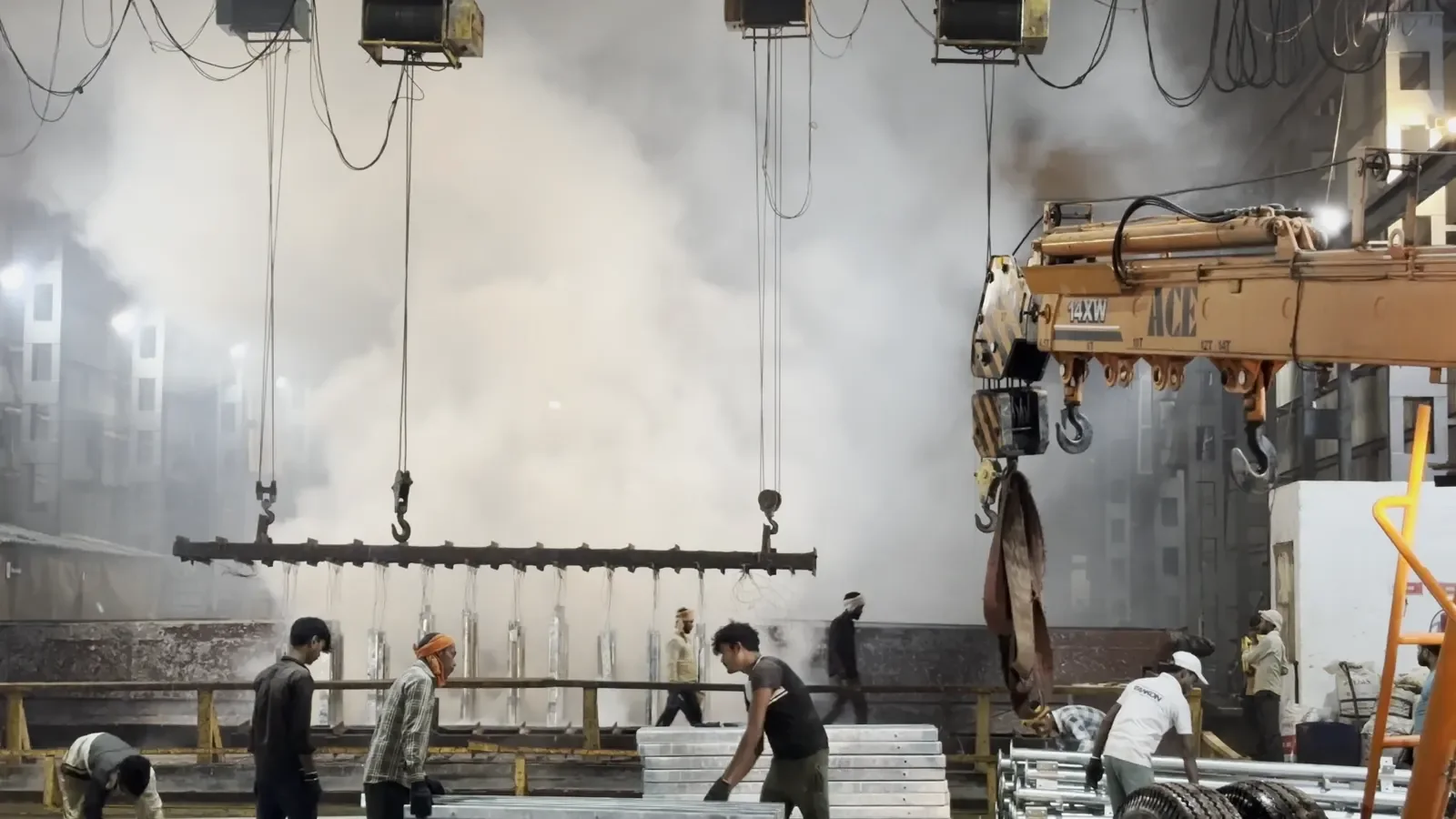
Real footage and a real render
日本語の概要
日本の鉄骨工事では、物決めの遅れが工程遅延の最大の要因とされています。KIMERU は、一つひとつの未決事項に期限と決定者を付け、工場に届く前に見える化するためのコンセプトです。
KIMERU は、元請・設計者・製作工場・専門工事業者が共有する 1 つの台帳を持ちます。各未決事項の最終決定期限は、建方日から稼働日で逆算し、国民の祝日を除いて計算します。すでにある日程と部材を取り込み、判定・定例資料・変更記録として返します。
元請または鉄骨製作会社の皆さまと、1 棟の 1 節を対象に、現在の未決事項リストと並行して運用する 6 週間のパイロットを共同で設計したいと考えています。期限超過の件数、製作着手日の安定性、承認 1 回あたりの日数を測定します。
Jemirae による独立したコンセプトスタディです。実際の受託案件ではありません。プロトタイプ内の企業名・案件・データはすべて架空です。
What we do, and what we don't
Today Jemirae brings industrial and enterprise UX, web software development, workflow digitisation and integration planning.
Read more
For a pilot we would work with an experienced steel works advisor for domain validation, and with CAD and production system vendors for any integration.
Jemirae does not provide structural engineering, fabrication or steel inspection services. KIMERU coordinates decisions. It does not make engineering judgements.
Co-design a six-week pilot
We would like to co-design a 6-week pilot on one building's erection tier with a general contractor or fabricator, running alongside your existing 未決事項 list. We would measure overdue decisions, release-date stability and approval round time.
Sources
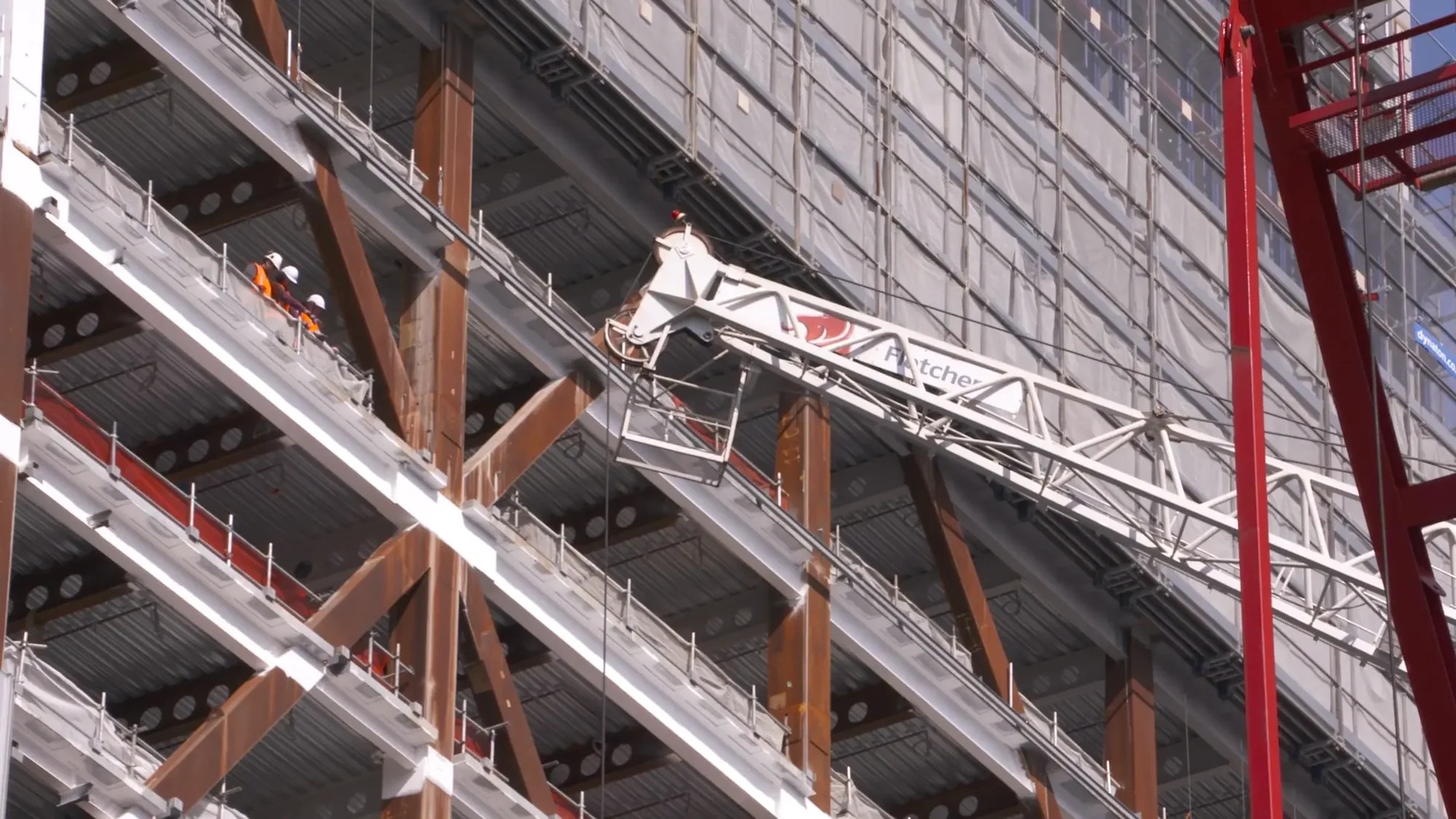
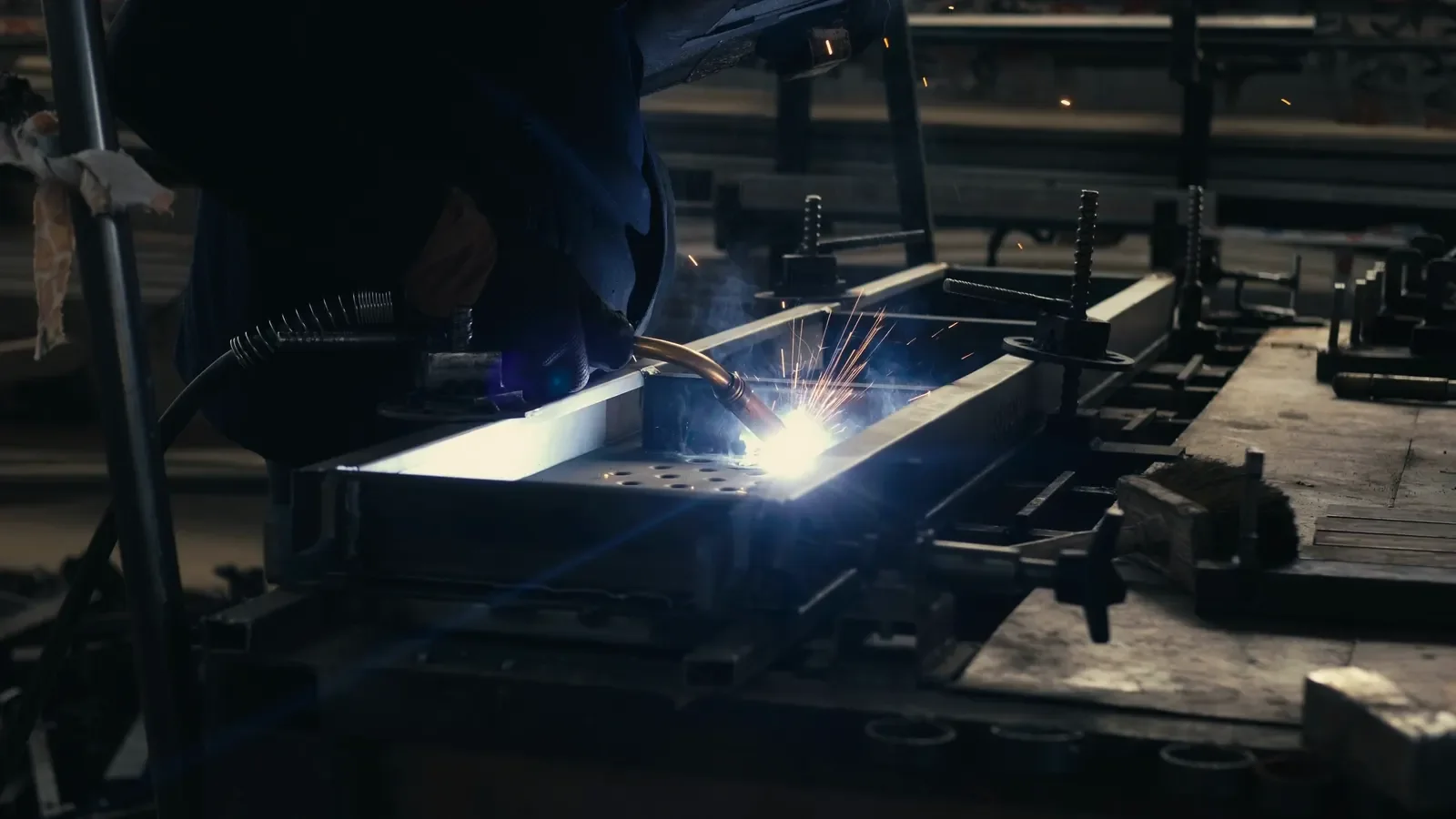
Footage and stills: Pexels contributors, used under the Pexels licence. Building renders and drawings: made by Jemirae for this study. Independent concept study by Jemirae. Not a client engagement. All companies, projects and data in the prototype are fictional.